

North versus South. An age-old divide that has shaped the history, politics and cultures of entire nations. The assertion of one’s roots, the defence of differences, the search for an identity defined, at least in part, through its relationship with others: these are recurring dynamics in human societies, often turning diversity into rivalry. Yet there is another way to approach this divide. One that does not erase differences, but embraces them, turning them into an opportunity for collective growth. That is the lesson coming from the Montagne de Reims, where 12 Champagne vignerons have chosen to look beyond geographical boundaries and join forces to showcase the richness of their terroirs.


Champagne: 12 Vignerons from Verzy, Verzenay, Bouzy and Ambonnay
Verzy and Verzenay to the north. Bouzy and Ambonnay to the south. Four villages, four distinct identities, an extraordinary winegrowing heritage and a shared affinity for Pinot Noir, one of the region’s most compelling expressions, alongside Chardonnays of remarkable finesse.
The producers involved are Champagne Sacy Soeur & Frère, Champagne Pierre Deville and Champagne Adrien Renoir from Verzy; Champagne Rousseaux-Batteux, Champagne Mathieu Godmé-Guillaume and Champagne Péhu Simonet from Verzenay; Champagne Brice, Champagne Pierre Paillard and Champagne Georges Rémy from Bouzy; and Champagne Egly-Ouriet, Champagne R.H. Coutier and Champagne Marguet from Ambonnay.
The initiative grew out of a shared desire to introduce their wines and the places that shape them to a wider audience. But its significance extends well beyond the tasting itself. It demonstrates how promoting a wine region can become a collective endeavour, one that raises the profile of every producer involved.


From Reims to Paris: Montagne de Reims Vignerons Gather at Chais d’Œuvre
After last year’s gathering in Reims, the vignerons chose Paris for their latest meeting.
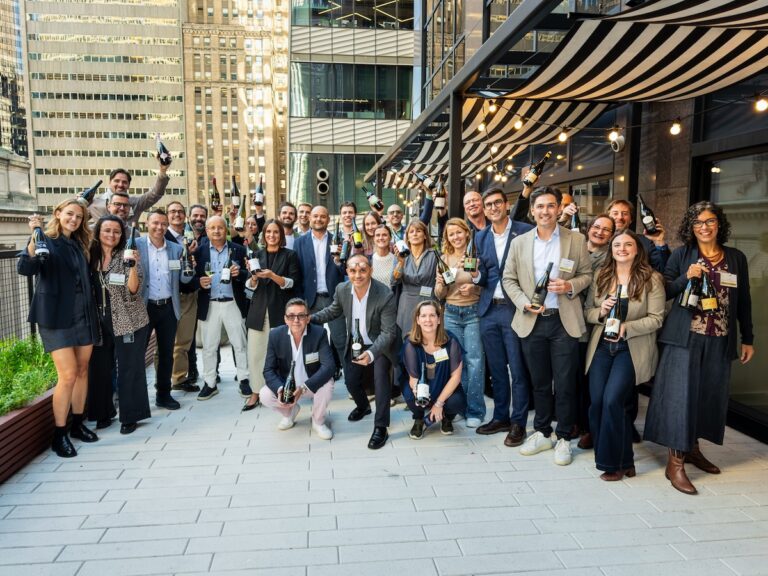
On Monday, October 12, in a city that remains one of the world’s leading showcases for wine and gastronomy, Chais d’Œuvre hosted a tasting with a difference.
Founded by Manuel Peyrondet, who was named Meilleur Sommelier de France in 2008, the wine club provided the setting for an encounter between six producers from the northern slopes of the Montagne de Reims and six from its southern side.
Throughout the day, they welcomed restaurant professionals, sommeliers, distributors and wine merchants. The response was impressive: a room buzzing with activity, visitors from several countries and an audience genuinely interested in discovering, comparing and understanding the wines.
Moving from one tasting table to another, glass in hand, there was a palpable sense of openness and shared purpose.
This was about more than showcasing individual cuvées. It was an opportunity to tell the story of a winemaking culture, bring different perspectives into conversation and demonstrate how the same winegrowing area can give rise to remarkably diverse interpretations.
And therein lies the real strength of the initiative.


Stronger Together: A Lesson from Champagne’s Vignerons
In the wine world, where reputations are built over time through quality, consistency and a recognisable identity, making outstanding wines is not always enough.
Producers also need to bring those wines to the attention of the right people, cultivate relationships, reach new markets and find their place in an increasingly crowded international landscape.
Quality is the starting point. But knowing how to communicate it, and creating genuine opportunities for people to experience it, is what can turn excellence into recognition.
The 12 vignerons of the Montagne de Reims seem to have understood this particularly well.
By coming together, they have chosen to share resources, connections and opportunities without compromising the individuality of their respective domaines.
Collaboration, in this case, does not dilute identity. It gives each identity greater visibility.
Because joining forces does not mean becoming the same. It means recognising that differences can make everyone stronger.
The North does not need to become the South to engage with it, any more than the South needs to abandon its own character. Quite the opposite: it is precisely the distinctive personality of each terroir that makes the dialogue worthwhile.
There is also a valuable strategic insight behind this approach.
When a producer presents their wines alone, they are asking the market to recognise an individual identity. When producers come together around a shared project, they create something larger: an occasion that can attract greater attention, open doors and foster new relationships.
Everyone stands to benefit, provided each remains true to their own character.


Promoting Terroir, Reaching New Markets: The Power of a Shared Vision
Looking beyond one’s home territory does not mean leaving one’s roots behind. It means giving those roots the chance to be discovered, understood and appreciated by a wider audience.
I hope initiatives like this inspire many others.
Not because every wine region should follow the same formula, but because the wine world needs more opportunities for dialogue, cooperation and openness.
With this gathering in Paris, the Montagne de Reims has shown that differences are not necessarily barriers to overcome. They can be the very foundation of a shared ambition.
And perhaps that is the most important lesson of all.
In wine, as in so many other fields, success does not always belong to those who manage to make their way alone. Sometimes, the more ambitious choice is to discover just how far we can go together.
Chapeau to the vignerons of the northern and southern Montagne de Reims. Long live the vignerons of North and South. See you in 2027!