


Italian wine is losing regular drinkers, red wines are under pressure and exports are no longer able to offset declining domestic consumption as effectively as they once did. Yet the downturn is far from uniform. While global wine consumption continues to fall, sparkling wines are proving more resilient, and markets such as Romania, Vietnam and Poland are recording growth in Italian wine imports well above the average. These are among the findings presented by Denis Pantini, Head of Nomisma Wine Monitor, on 10 October 2026, during an event celebrating Cantina Rauscedo’s 75th anniversary. His analysis challenges some of the most common explanations for the difficulties facing the wine industry, starting with the assumption that younger generations are chiefly responsible for declining consumption. The figures suggest otherwise. Over the past twenty years, the proportion of Italian wine drinkers who consume wine regularly has fallen from 57% to 39%. Meanwhile, the share of 18- to 24-year-olds among all wine consumers has remained virtually unchanged. The real shift lies in drinking frequency, particularly among generations that traditionally enjoyed wine with meals.
Internationally, the export-led model that sustained the Italian wine industry for two decades is also showing signs of strain. Italy now exports almost one in every two bottles it produces, but wine exports fell by 6% in value in the first half of 2026. The United States, Italy’s largest wine export market by value, is facing a particularly difficult period, compounded by trade tensions.
Pantini, however, warns against mistaking a slowdown for inevitable decline. Consumer behaviour is changing, traditional markets are under pressure and new opportunities are emerging elsewhere.
We have brought together the key points of his analysis in this interview to examine the challenges and opportunities facing Italian wine producers and distributors.

Has Italian Wine Entered a Structural Crisis?
We are facing something of a perfect storm, with structural and cyclical factors coming together. But we should not forget how far the Italian wine industry has come. It has enjoyed a long period of growth and shown a remarkable ability to adapt.
Over the past twenty years, domestic wine consumption has fallen by 25%, while production has declined by a much smaller 12%.
How was that possible? Largely through internationalisation. Between 2005 and 2025, Italian wine exports increased by 33% in volume. In 2005, we exported 31% of our production. Today, that figure stands at 48%.
Twenty years ago, we sold three out of every ten bottles abroad. Today, it is almost one in two.
Exports allowed the industry to maintain relatively stable production despite falling domestic demand. The difficulty now is that many international markets are slowing down too.
We could not necessarily have predicted everything that is happening, but we could probably have prepared better. Understanding the data and the changes under way is essential to developing an effective response.
Are Younger Generations Really Responsible for Italy’s Declining Wine Consumption?
This is a point that needs to be clarified. Younger people are often blamed for falling wine consumption, but the data tell a different story.
In 2006, consumers aged 18 to 24 represented 6% of all Italian wine drinkers. In 2025, they still accounted for 6%. Their share has not suddenly collapsed.
Of course, demographics are changing. Italy’s population is declining and ageing. It exceeded 60 million in 2015, fell to approximately 58.9 million in 2025 and is projected to reach 57.9 million by 2035.
But the most important change concerns how frequently people drink wine.
In 2006, 57% of Italian wine consumers said they drank it daily or several times a week. By 2025, that figure had fallen to 39%.
The striking point is that the steepest decline has not occurred among younger consumers, whose regular drinking habits have remained relatively stable, but among middle-aged and older generations.
Among 55- to 59-year-olds, for example, the proportion drinking wine regularly has dropped from 67% to 39%.
People who grew up in a culture where wine was routinely served with meals are drinking it less frequently. That is one of the main reasons for the decline in domestic demand.
Why Are Red Wines Suffering More Than Other Categories?
Partly because red wine is more closely associated with regular drinking at mealtimes.
Our research shows that 41% of still red wine consumers drink it daily or two to three times a week. That compares with 30% for still whites, 16% for sparkling wines and 11% for rosés.
As everyday wine consumption declines, reds are particularly exposed.
This is not a new development. Between 2015 and 2025, still reds’ share of Italian wine consumption fell from 40.6% to 36.9%, while sparkling wines increased their share from 10.5% to 15.1%.
Climate change is also playing a part. Summers are getting longer, and high temperatures persist for extended periods. In those conditions, a Barolo with 16% alcohol is not necessarily the first wine people reach for.
Climate and changing drinking occasions are both reshaping consumer preferences.
What Do Retail Sales Tell Us About the Shift Towards Sparkling Wine?
Supermarket sales confirm a growing divide between categories.
In the first eight months of 2026, sales of still and semi-sparkling wines declined by 3.2% in volume and 2.1% in value.
Reds performed worst, falling by 4.4% in volume and 3.6% in value. Whites proved more resilient, declining by 1.9% in volume and just 0.5% in value.
Sparkling wines, meanwhile, continued to grow, with sales up 2.7% in volume and 2.2% in value.
Growth was driven mainly by dry Charmat-method sparkling wines, including Prosecco, and traditional-method wines.
Traditional-method sparkling wines account for less than 10% of category sales, yet recorded increases of 13.9% in volume and 9.4% in value.
Over the longer period from 2017 to 2025, sparkling wine sales in large-scale retail rose by almost 50% in volume, while red wine sales fell by around 20%.
These figures show why we cannot treat wine demand as a single, homogeneous market. Different categories are moving in very different directions.
Is the Wine Market Becoming More Polarised by Price?
Yes, and it is a significant trend.
At one end, the entry-level segment is holding up, supported by consumers who buy wine regularly and are primarily looking for affordability.
At the other, premium wines are gaining ground among consumers who may drink less often but choose higher-quality bottles when they do.
The middle of the market is under the greatest pressure.
This tells us something important about how people’s relationship with wine is changing. Purchasing decisions are shaped not only by price, but also by drinking frequency and occasion.
For producers, affordability remains crucial. But there are also consumers willing to pay more for wines that offer something distinctive.
How Important Are Cooperatives to Italian Wine Exports?
Cooperatives account for approximately half of Italy’s wine production, so they are fundamental to the industry.
We compared the ten largest Italian wine cooperatives by turnover with the ten largest non-cooperative companies, looking at exports as a proportion of revenue.
In 2025, exports accounted for 56% of turnover among the cooperatives, compared with 78% among non-cooperative businesses.
There are substantial differences between individual companies. La Marca Vini e Spumanti generates 88% of its turnover abroad, Gruppo Mezzacorona 80% and Cavit 72%. These are cooperatives with a strong international presence.
Overall, however, non-cooperative companies are more export-oriented.
Their contribution to Italian wine exports has also grown more rapidly. Between 2019 and 2025, the ten leading cooperatives increased their share of national exports from 17% to 18%, while the ten leading non-cooperative companies rose from 23% to 25%.
But does the cooperatives’ lower dependence on exports represent a strength or a weakness?
The figures alone cannot answer that. We also need to consider how the domestic market is evolving, because a greater reliance on Italian consumers can have very different consequences depending on consumption trends.
How Serious Is the Slowdown in Italian Wine Exports in 2026?
The situation is certainly complex.
In the first half of 2026, Italian wine exports fell by 6% in value and 3.9% in volume.
Bottled still and semi-sparkling wines declined by 8.9% in value and 5.9% in volume. Sparkling wines performed considerably better, recording a 0.4% increase in value and a decline of just 0.7% in volume.
The picture becomes even more challenging when we look at the main import markets.
In the first seven months of 2026, only three of the twelve major markets analysed recorded an increase in the value of wine imports from Italy: Japan, up 1.2%; France, up 1.5%; and Brazil, up 7.5%.
In the United States, the value of Italian wine imports fell by 23.2%. The decline was 6.6% in the United Kingdom, 5.1% in Germany and 11.8% in Canada.
Taken together, these twelve markets reduced the value of their purchases from Italy by 11.8%, compared with a 10.8% decline in their total wine imports.
We are clearly going through a particularly difficult period.
How Are Falling Consumption and Tariffs Affecting the US Market?
The United States remains Italy’s largest wine export market by value and is currently one of the industry’s biggest concerns.
Over the past three years, American wine consumption has fallen from approximately 35 million hectolitres to just over 32 million.
That is a significant contraction, although imports have held up better than overall consumption. This means domestically produced American wines have been more severely affected than imported wines.
For Italian exporters, that is relatively encouraging, but it does not remove the difficulties.
The tariffs introduced by the Trump administration have further complicated matters.
Trade tensions have prompted reactions elsewhere. Canada, for example, has removed American wines from shelves in several retail channels, while China has introduced additional barriers.
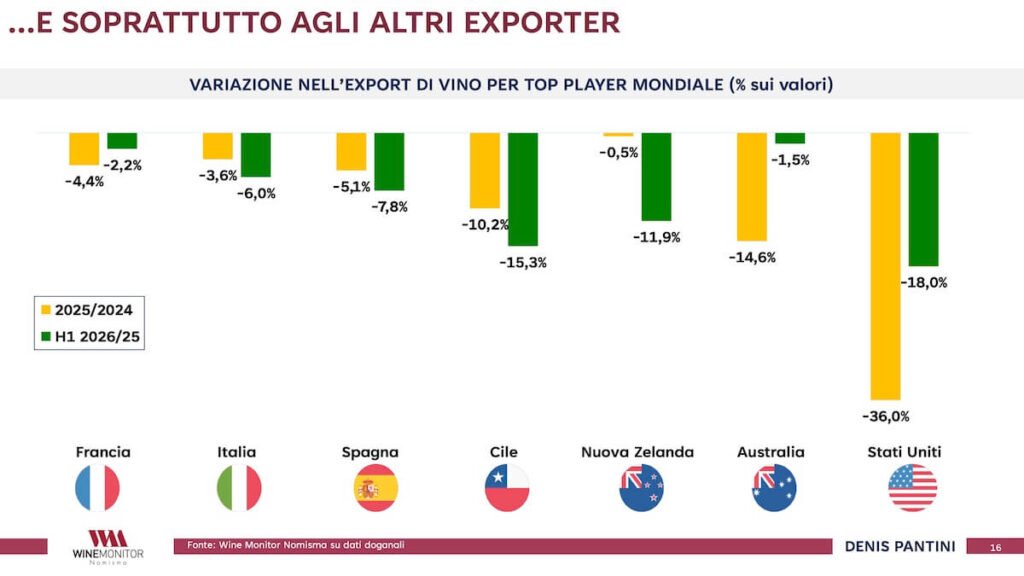
The consequences for US wine exports have been particularly severe. Their value fell by 36% in 2025, followed by a further 18% decline in the first half of 2026.
It shows that tariffs hurt everyone: not just the countries targeted by them, but also those imposing them.
Is Italian Wine Losing Competitiveness Against Other Major Exporters?
We need to distinguish between the current difficulties and longer-term performance.
In the first half of 2026, Italian wine exports declined by 6% in value. But Spain fell by 7.8%, Chile by 15.3% and New Zealand by 11.9%. France limited its decline to 2.2%, while Australia recorded a fall of 1.5%.
The slowdown is affecting many of the world’s leading wine exporters.
There is another important consideration.
Compared with other leading Made in Italy sectors, such as fashion, furniture and automation, the wine industry has performed relatively well over the past decade.
Between 2015 and 2025, the value of Italian wine exports increased by approximately 45%.
Other industries are also experiencing downturns driven by economic, geopolitical and commercial factors that extend well beyond wine.
That may offer little consolation, but it matters when assessing the wider picture.
Are There Any Signs of Recovery in the Second Half of 2026?
One encouraging indicator comes from bottling figures.
In September 2026, bottling volumes rose by 4.9% compared with the same month a year earlier, following a 4.2% decline in August.
A single month is not enough to establish a lasting turnaround, but it is a development worth monitoring.
Looking at the first nine months of 2026, however, the differences between categories remain clear.
Still whites increased by 1.8% and sparkling wines by 1.3%. Still reds declined by 8.8%, while rosés fell by 12.2%.
Any recovery is therefore far from uniform.
What Matters Most to Wine Consumers Today: Price, Sustainability or Origin?
Price has become increasingly important in purchasing decisions, partly because household purchasing power has declined.
But other considerations have not disappeared.
Sustainability, in particular, has received less attention in public debate recently, yet it remains important to consumers.
Our research shows that sustainability matters to 73% of Italian wine consumers, 55% of British consumers, 42% of German consumers and 59% of consumers in the Nordic countries surveyed.
Origin is another important factor.
In Italy, 70% of respondents attach importance to quality and origin certifications such as PDO and PGI. Brand recognition also continues to influence purchasing decisions.
These findings suggest that, alongside affordability, there are other attributes that can help wines stand out and command greater value.
They remain areas worth investing in.
Are No-Alcohol Wines a Genuine Growth Opportunity?
Opinions differ, but we need to look at the data.
Consumers are becoming increasingly conscious of health and wellbeing. Their concerns extend beyond alcohol content to calories, sugar and other nutritional factors.
This is helping drive interest in dealcoholised wines.
Between 2021 and 2025, global consumption of alcohol-free sparkling wines increased from approximately 53.6 million to 87.3 million bottles.
Over the same period, alcohol-free still wines grew from around 43.7 million to 65.9 million bottles.
These volumes remain relatively small compared with the global wine market, but the growth rates are significant.
In countries such as the United States and Germany, these products have been available for longer and have already established a consumer base.
Even in a shrinking market, there are segments capable of meeting new and different consumer needs.
Can Wine Tourism Become a Significant Source of Income for Italian Wineries?
Wine tourism offers a tangible opportunity, particularly because it allows wineries to supplement income from wine production and sales.
Tourist arrivals in many of Italy’s leading wine regions have grown faster than the averages recorded in their respective regions.
Between 2019 and 2024, arrivals in Conegliano Valdobbiadene increased by 26.5%, compared with 8.3% across Veneto.
In Collio, growth reached 27.9%, against 11.4% for Friuli-Venezia Giulia. Franciacorta recorded an increase of 16%, compared with 5.7% across Lombardy.
The Barolo area grew by 17.6%, against a regional average of 3.4% in Piedmont.
Tuscany recorded particularly strong results: Brunello di Montalcino was up 39%, Vino Nobile di Montepulciano 33% and Bolgheri 28%, compared with a regional average of 6.7%.
Of course, visitors are not drawn to these destinations by wine alone. Landscapes, culture, gastronomy and other attractions all play a role.
But wine is central to their identity, and wineries are well placed to benefit from that interest.
According to the estimates cited in our analysis, wine tourism can provide supplementary income averaging around 18–20%.
Which Markets Offer the Greatest Potential for Italian Wine Exports?
I believe we need to look more closely beyond our traditional export destinations.
It is understandable that companies focus on familiar, nearby or high-spending markets, such as the United States.
But many other countries are growing and deserve closer attention.
We analysed Italian wine exports between 2015 and 2025, focusing on markets that purchase at least €10 million worth of Italian wine annually.
While overall export value grew by 45%, Romania recorded an increase of 507%.
Turkey grew by 325%, Vietnam by 264%, Poland by 249%, Azerbaijan by 240%, the Czech Republic by 235% and Bulgaria by 209%.
South Korea, Mexico, Australia and Croatia also recorded above-average growth.
These rates do not mean that the markets concerned have already reached the scale of Italy’s traditional export destinations. But they are important signals.
In Eastern Europe, rising incomes are supporting consumption growth. There are also promising opportunities in Asian markets such as Vietnam and South Korea, as well as in Latin America.
Not every wine will succeed in every market. That is why producers need to understand individual destinations rather than applying the same strategy everywhere.
What Will Be the Defining Challenge for Italian Wine?
The industry is going through a difficult period, but we should not assume that the market is destined to keep shrinking.
Over the past twenty years, Italian wine has shown an extraordinary ability to adapt.
We have offset falling domestic consumption through exports and developed new markets.
Today, new opportunities are emerging in categories and activities that meet different needs: sparkling wines, no-alcohol wines, wine tourism and international markets growing faster than the average.
The challenge is to recognise those opportunities and understand what drives them.
We need to identify where the potential lies, interpret the changes taking place and develop strategies to make the most of them.
That ability to understand and respond to the market is what can put the Italian wine industry back on a path to growth.


