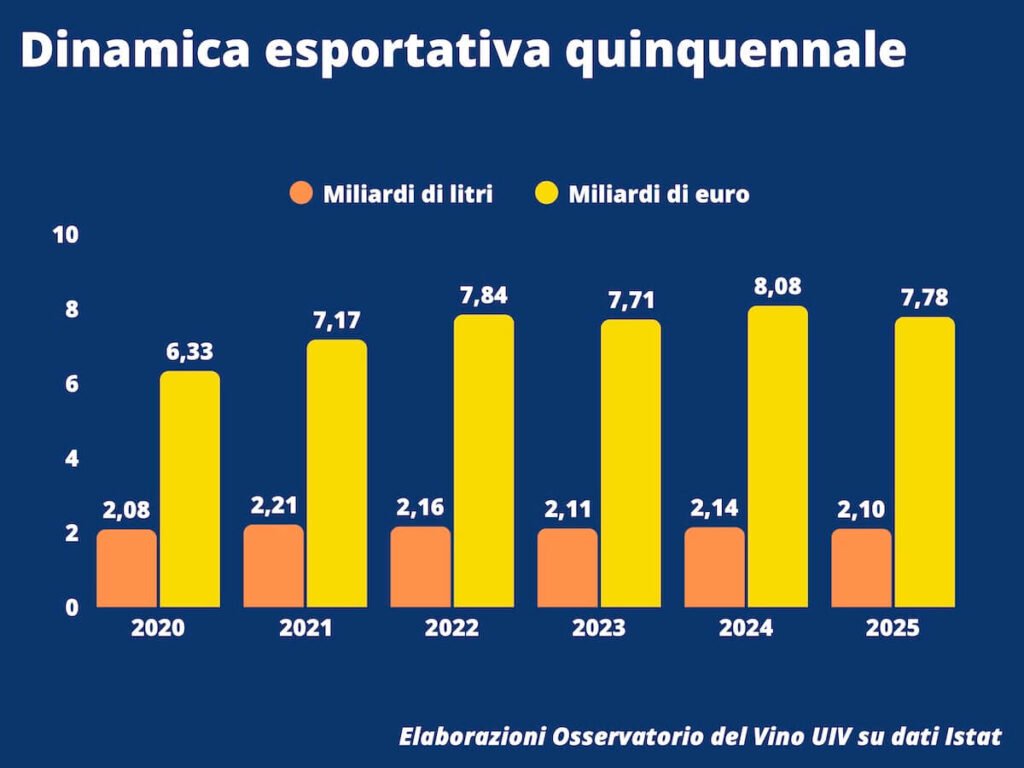
Italian wine exports closed 2025 at €7.78 billion, marking a –3.7% decline from 2024 and losing €300 million year‑on‑year. Volumes reached 21 million hectoliters, down –1.9%, according to the analysis by the Uiv Observatory based on Istat data. The contraction, Uiv states, is largely due to the pressure of U.S. tariffs, currency dynamics, and the generalized slowdown of non‑EU markets. Exports to third countries fell –6.4%, with a dramatic –11.6% drop in the second half of the year, while the European Union proved more resilient, closing with a slight +0.5%, equal to nearly €3.2 billion.
Wine Exports to the U.S.: 2025 Ends at –9.2%, but France Plunges Twice as Much
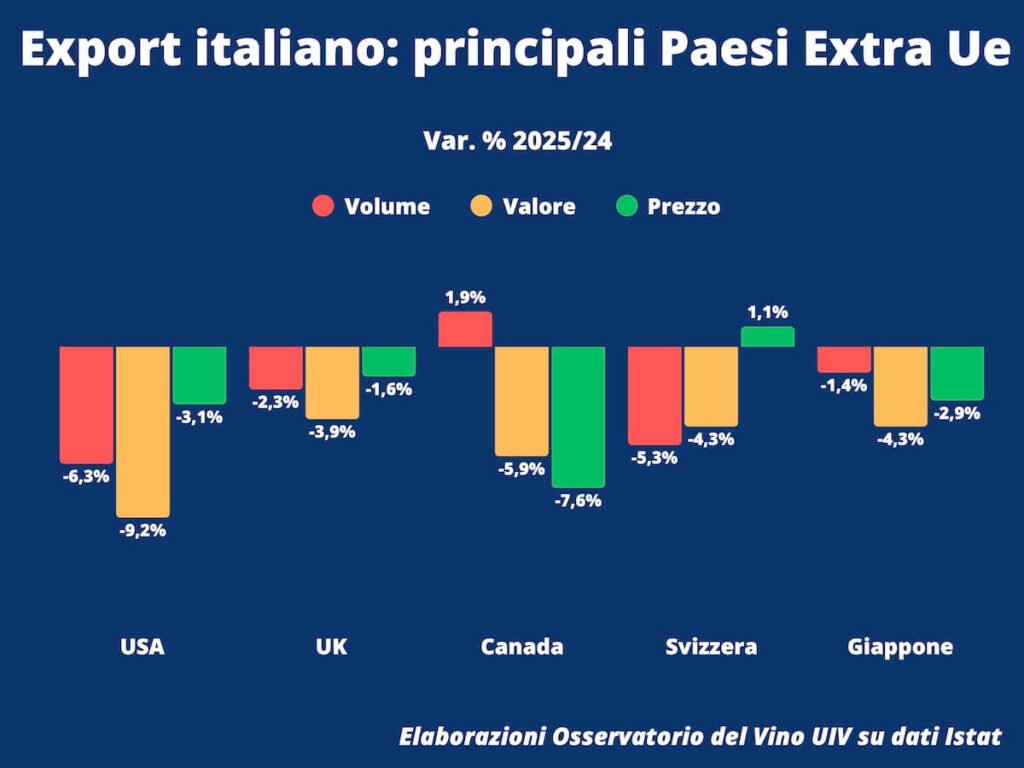
The most penalizing market is the United States, which drops to €1.76 billion, with a –9.2% decline, equal to €178 million lost in just one year.
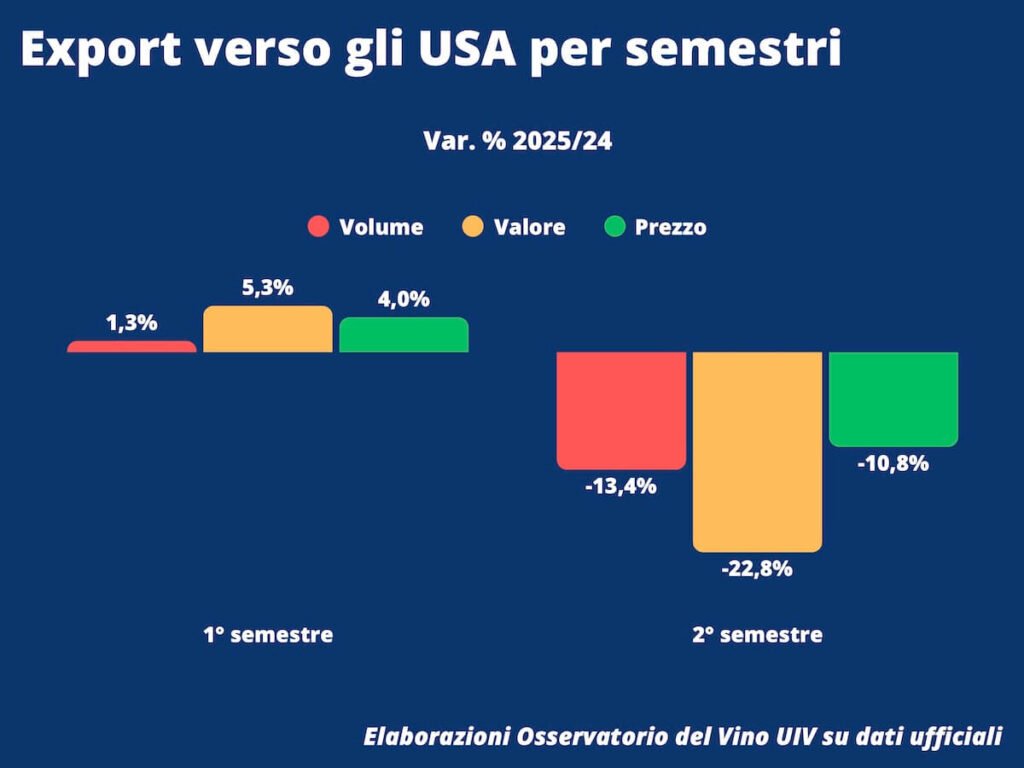
“The difficulties encountered in third countries in the second half are unprecedented,” comments Paolo Castelletti, Uiv General Secretary. “In particular in the U.S., we see a decline approaching 23% during the period, with peaks of –28% for bottled still reds, along with a 10.8% drop in average prices.”
According to Uiv, the U.S. scenario is so distorted that it affects competitors as well:
“France ends the year with a drop twice ours: –18.8% (–39.1% in the second half).”
Paradoxically, Italy’s smaller decline allows it to recover market share in the U.S.—“a Pyrrhic victory we would have preferred to achieve through growth.”
Tables clearly show the fracture between the two halves:
- H1 2025: Italian wine in the U.S. still growing in volume (+1.3%), value (+5.3%), and price (+4%)
- H2 2025: collapse to –13.4%, –22.8%, and –10.8%, respectively
Europe Holds Steady: Germany, France and the Netherlands Offset Losses Outside the EU
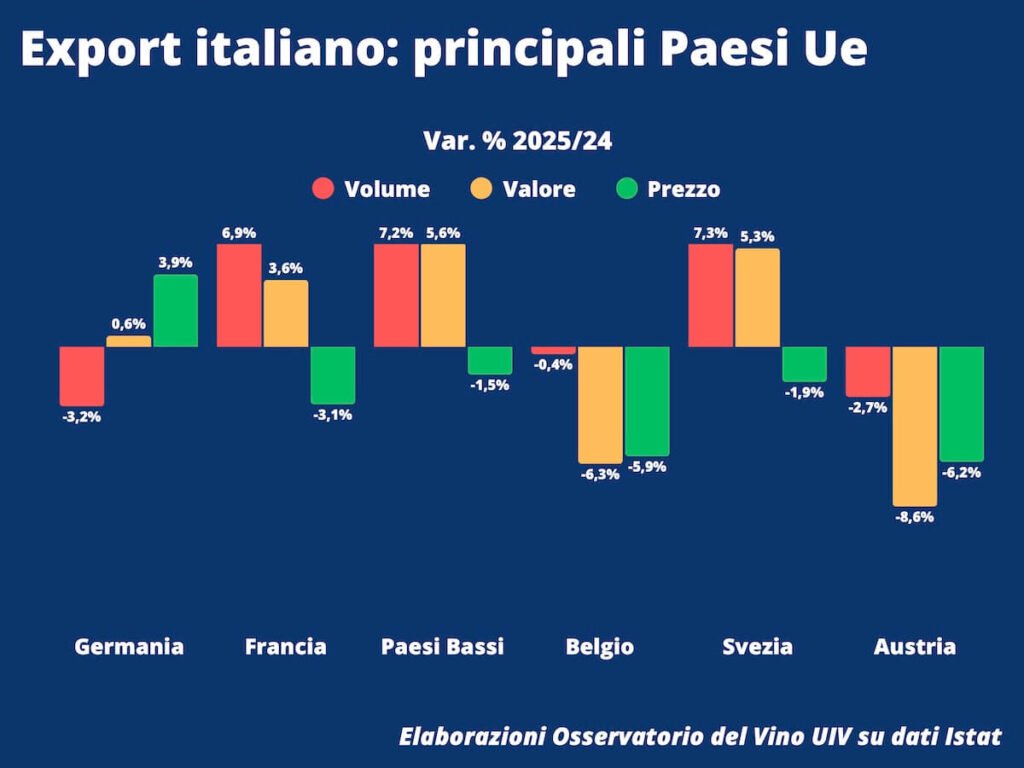
Across Europe, the situation is very different.
Germany closes with slight growth (+0.6%), as do the Netherlands (+5.6%) and France (+3.6%), confirming the EU as the most stable area in 2025.
Uiv President Lamberto Frescobaldi emphasizes this dynamic: “Europe has cushioned the loss, and this is exactly where we must start again: the internal market would offer enormous growth potential if we overcame the legislative Babel that effectively imposes an internal duty of 45% on manufactured goods.”
According to Frescobaldi, the “wake‑up call” generated by U.S. tariffs must push the Italian sector to “put our own house in order and at the same time broaden our horizon across third markets, with commercial activism, managerial approach and strategic cooperation with institutions.”
Sparkling Wines More Resilient Than Still Wines, but Prices Fall Everywhere
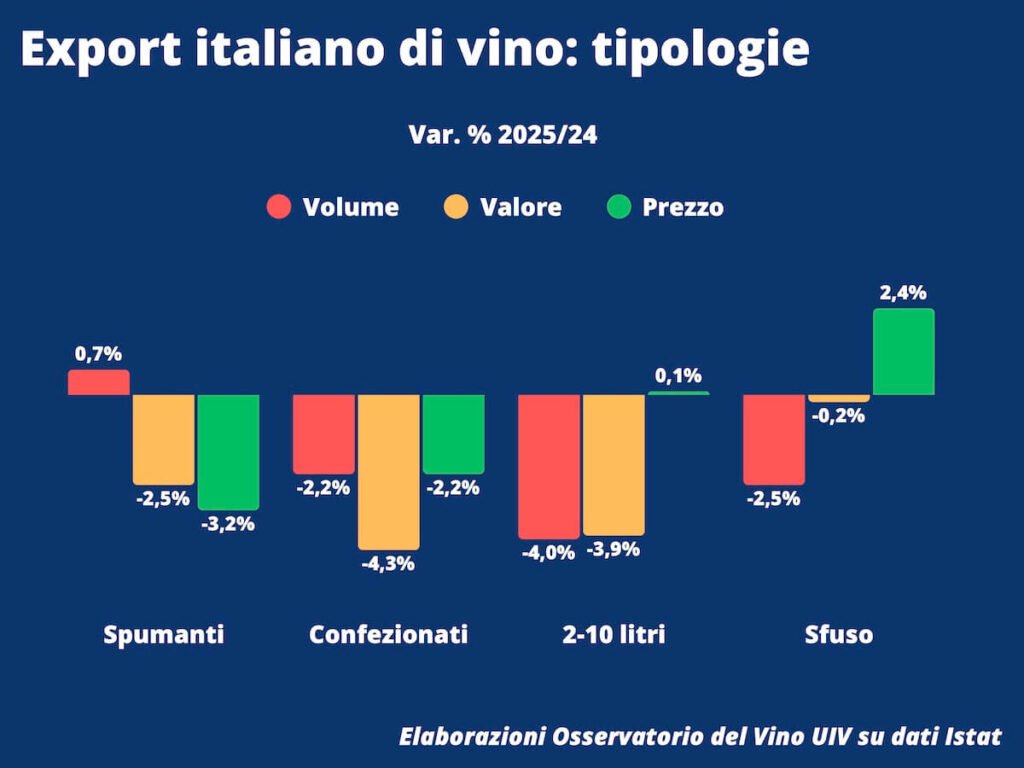
The Uiv Observatory tables show different behaviors across categories:
- Sparkling wines limit losses to –2.5%, with a milder volume drop and stable prices (+0.1%)
- Still and semi‑sparkling wines fall –4.3% in value, showing greater exposure to non‑EU dynamics
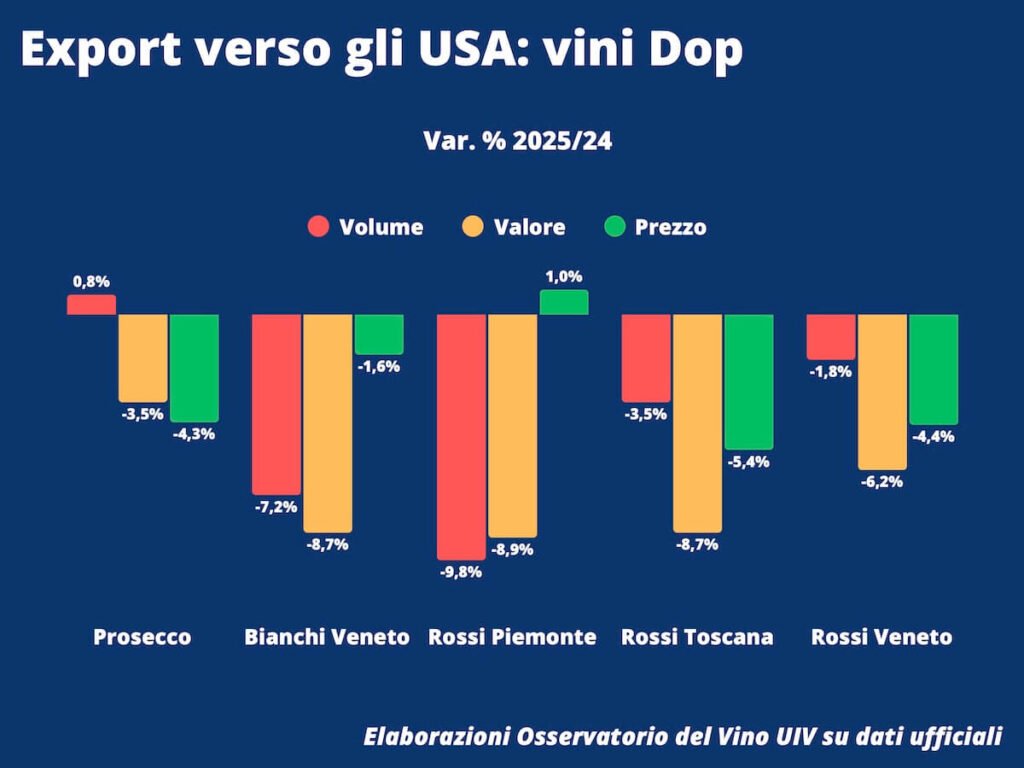
In the PDO segment destined for the U.S., charts show a major contraction especially for reds.
Prosecco and Veneto whites, despite negative figures, show greater resilience than Piedmontese and Tuscan reds, where average price declines reach –9.8% and –8.7%.
Non‑EU Wine Exports: Only Brazil Is Growing
Among major non‑EU countries, only Brazil posts a positive result in 2025: +3.8%.
The general framework is negative:
- United Kingdom –3.9%
- Canada –5.9%
- Switzerland –4.2%
- Russia –16%
Japan also slows down, with negative variations in both value and volume.
Performance of Leading Regions: Veneto, Tuscany and Piedmont Down
The three leading export regions all show negative results:
- Veneto –1.2% (€2.9 billion)
- Tuscany –2%
- Piedmont –2.2%
A slowdown that mirrors the performance of their main reference markets, heavily influenced by global economic conditions.
Five Years of Wine Exports: Cyclicality, Stagnation and External Shocks
In the period 2020–2025, Uiv data (Istat-based) show an uneven dynamic:
- 2021: €6.33 billion
- 2022: €7.84 billion
- 2023: €7.71 billion
- 2024: €8.08 billion
- 2025: €7.78 billion
A cycle marked by inflation, trade tensions and currency devaluations that have clearly affected global purchasing power. The difficulties encountered in 2025 underline the urgency, according to Uiv, of strengthening presence in Europe and building a more aggressive strategy toward Asian and emerging markets. The U.S. situation demands caution but simultaneously confirms the centrality of Italian exports in the global competitive landscape.