


At Milan Design Week 2026, amid immersive installations and new expressions of contemporary luxury, Maison Veuve Clicquot chose to tell its story through a project that goes far beyond the bottle. Chasing the Sun, created by artist and designer Yinka Ilori—known as the “Architect of Joy”—is a declaration of intent: transforming the Maison’s signature sense of radiance into a living, shared, and accessible experience.
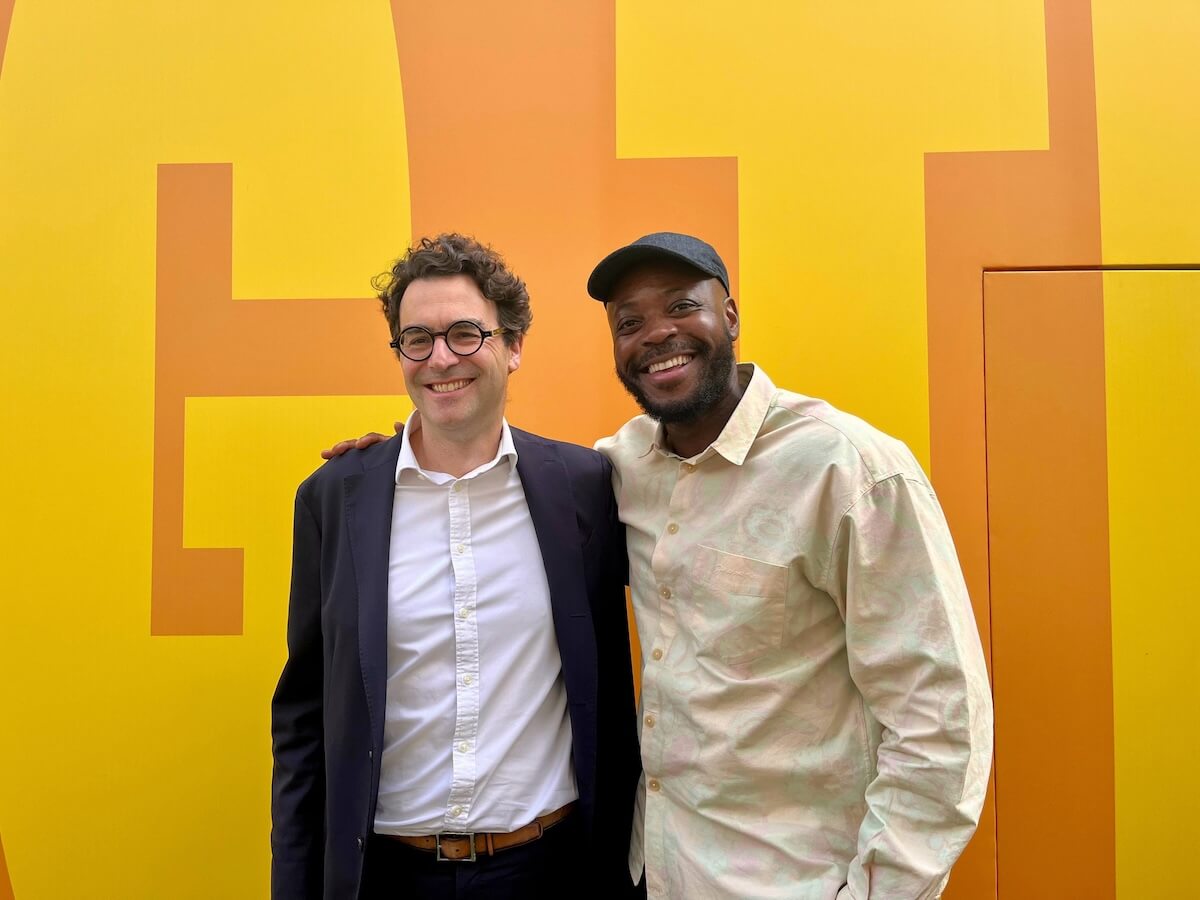
It is within this context that we met Thomas Mulliez, appointed President and CEO of the Maison at the end of 2025, succeeding Jean‑Marc Gallot after more than a decade of leadership. A generational transition that marks a new phase for Veuve Clicquot, balancing continuity and vision, built on an international path that led Mulliez—after joining Moët Hennessy in 2020 and serving as President for the EMEA region—to a deep understanding of global markets and the dynamics of contemporary luxury.
Chasing the Sun thus becomes the starting point for a broader conversation about the future of Champagne, the ability of a historic brand to renew its language, and the centrality of experience in the storytelling of wine. From the installation to the Clicquot Café—where the Maison’s iconic cuvées meet an all‑day menu designed to express its art de vivre—to the Clicquot Boutique featuring Ilori’s limited‑edition collection, the project unfolds as a complete narrative platform.
An opportunity to delve into the thinking of the new President and CEO and understand how Veuve Clicquot is redefining its role in a sector undergoing profound transformation—without losing its connection to its heritage, yet opening up to new forms of expression, relationships, and value.
What does Champagne represent for Thomas Mulliez?
“For me, Champagne represents essentially two things. First, it is synonymous with the highest quality: a wine that embodies the strength of the Champagne terroir and the importance of its full territorial identity. It is the demonstration of an exceptional product born from immense work—expertise, time, and care.
The second element is its deep connection with celebration: Champagne is, by nature, a wine that accompanies special moments.”
How did you enter the world of wine?
“I entered the world of wine out of passion. I was fortunate enough to be introduced to it from a young age—though not too young. My grandfather would always open great bottles at Christmas, with the idea of discovering and tasting. That led me to appreciate wine and to want to understand it more and more.
Before joining Moët Hennessy—where I have now worked for six years—I had experiences in very different sectors and companies. But the common thread was always the same: working for brands with heritage, savoir‑faire, tradition, and a strong connection to nature. That has always been fundamental for me and is what ultimately brought me into the world of wine. When I was looking for a new professional challenge, I had long wanted to work in this sector.”
What do you think of the current moment of transformation in the industry?
“Today’s challenges are multiple and complex. In the short term, we are facing an unfavourable economic environment: after the post‑Covid excess—when people celebrated more, drank more, and spent without much concern—we have returned to a phase of moderation, inflation, and declining consumption.
In the Champagne business, this has translated into a significant drop: after selling millions of bottles, last year the market recorded a decline of around 20%. It is a major challenge, but a short‑term one. I am convinced the market can recover.
Then there is the crucial issue of climate change. We do not know what Champagne will look like in twenty years. Before 2022, we had never harvested in August; since 2000, we have already had ten August harvests. This figure perfectly illustrates how the climate has evolved.

Work conditions in the vineyards are also changing rapidly: we have experienced periods of extreme heat followed, just weeks later, by frosts that likely destroyed up to 50% of the buds. This means significant losses in volume. The challenge is therefore not only about the style of the wine, but also about the quantities nature will allow us to produce in the future. There is no definitive answer today: we must learn, adapt, and change.
As for trends, low‑alcohol is real. It has an impact, certainly, but at the same time we see that people are drinking less—but above all, better. Proportionally, the impact on Champagne is smaller: the categories suffering the most are spirits and red wines.
Champagne remains a niche product in terms of volume, but extraordinarily strong in what it represents: quality, emotion, celebration, and joy. For this reason, despite short‑term challenges, the long‑term outlook remains positive.”
What does it mean to lead a Maison like Veuve Clicquot today?
“It is an enormous responsibility. First, toward the vineyards and the people who work in them every day, because conditions are changing drastically due to the climate. We must find ways to ensure proper working conditions despite these shifts.
There is also a responsibility toward consumers: promoting the idea of ‘drinking less but better’ is essential.
We also have a responsibility in how we produce: packaging must become increasingly sustainable. This is something we have been working on for a long time. Today, all our products are recyclable and reusable, designed to have a life beyond a single use.
Another important responsibility is explaining why a bottle of Champagne costs what it does. It is not arbitrary: behind it are an exceptional terroir, months of work in the vineyard, and months—sometimes years—of aging in the cellar before release. All of this justifies the value and reflects the quality of the final product.”

How does Thomas Mulliez see the future of Champagne and the Champagne region?
“From an agricultural perspective, everything depends on climate change. We are working but also learning as we go. Winters that are increasingly mild expose us more to spring frosts: in a single night, an entire harvest can be lost. Managing this risk is one of the greatest challenges for the future.
From a commercial perspective, the priority is explaining the value of Champagne and developing new markets. In Europe, many markets are mature and economies are no longer as strong as in the past. At the same time, the price of Champagne is rising because producing it costs more and more, partly due to the need to adapt to climate change. This could lead us to lose some consumers.
This is why finding new areas of growth is essential. The United States is a key market. Asia is also strategic: Korea is still small but promising, and in South America, Brazil is becoming very interesting, also thanks to new trade agreements between the EU and Mercosur. Africa is another continent where we are growing, we are already present, but we see great opportunities in countries like Nigeria, Ivory Coast, and Congo.
There are therefore pockets of growth capable of compensating for Europe. But Champagne is not—and will never be—a volume business: we can only produce what nature allows. It is a value‑driven game, built on explanation, education, and the ability to meet consumers who can recognize and support that value.”


