


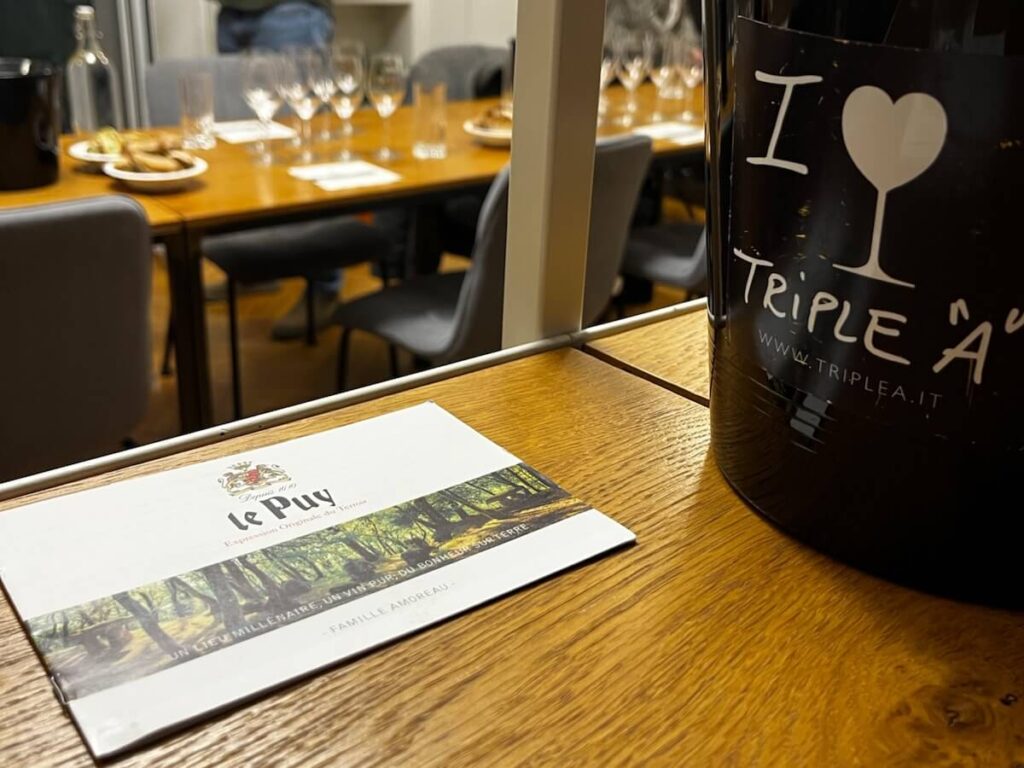
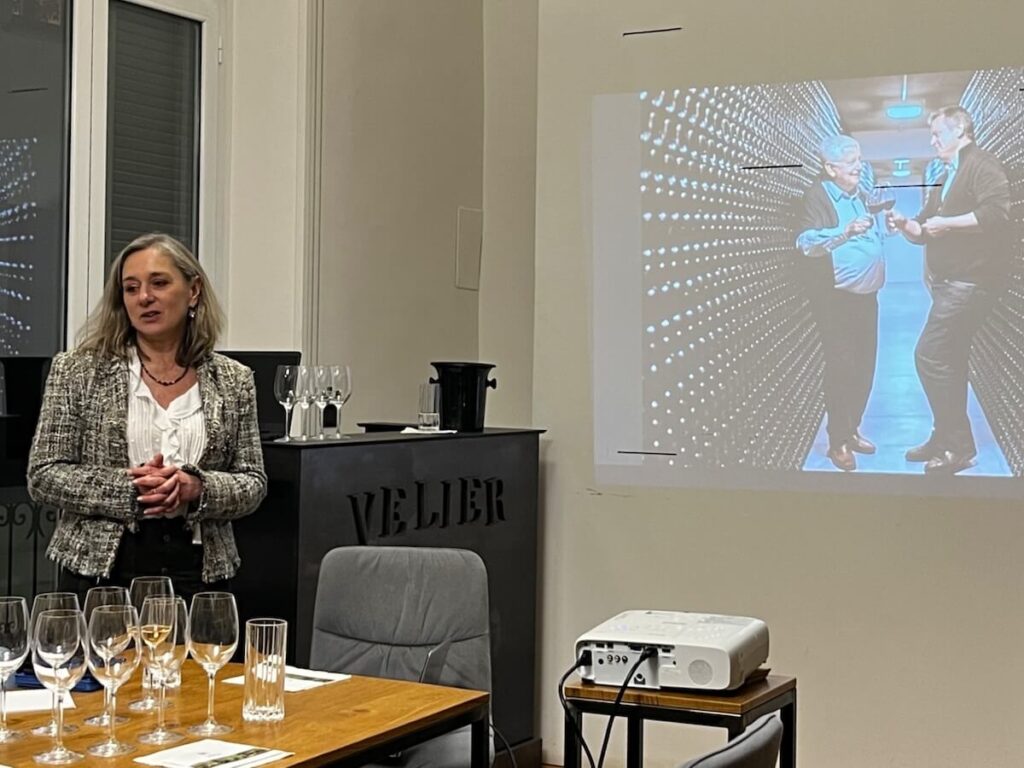
There are wines capable of carving out their own deeply personal trajectory, independent of conventions, appellations and even the rules of sacred territories such as Bordeaux. And yet, in doing so, they do not diminish—indeed, they amplify—their ability to express the place they come from. This is the case of Le Barthélemy, the signature label of Le Puy. A red born from the historic Les Rocs parcel, emblem of one of the oldest estates in the Bordeaux area, which—during a Milan vertical tasting of six memorable vintages led by the estate’s export manager Emeline Callet—showed how bottle ageing, biodiversity and minimal intervention in the cellar can become a truly unique enological language, a pursuit of the purest expression of terroir. The tasting was a moment that went beyond a purely technical approach, becoming an immersion into the philosophy of the Amoreau family, winegrowers since 1610 and now in their 15th generation, pioneers of organic and biodynamic farming long before these became trends.
Le Puy: over four centuries of history and wine at the highest point of Bordeaux
Le Puy means “the highest point”. And it is not just a symbolic definition. The estate sits at 107 meters above sea level, one of the highest elevations in the Bordeaux area, on the same limestone plateau as Saint‑Émilion and Pomerol.
Of its 124 total hectares, 78 are dedicated to vineyards and 46 form an autonomous ecosystem of forests, meadows, orchards, lakes and wild areas. A choice that reflects the Amoreau family’s vision: the vineyard not as a monoculture, but as a complex organism in balance with its surroundings.
Here, biodynamics is presented as a continuation of tradition rather than a revolution. Jean Pierre Amoreau was among the founders of Demeter, and since 2009 horses have returned to work the soils to preserve their microbiological vitality. Today, three people are dedicated exclusively to soil care, alongside four horses.
Leaving the AOC Bordeaux and embracing the freedom to experiment
Since 2017, Le Puy has left the AOC Bordeaux, also giving up the right to use the term “Château”. A radical decision taken to maintain production coherence independent of appellation rules. According to what Emeline Callet explained during the tasting, stepping away from traditional terminology—renouncing the word “Château”—has not had a significant impact on the estate’s image.
This choice fits into a broader philosophy of experimentation. Alongside the historic Le Barthélemy parcel, for example, Le Puy has been cultivating more than 20 different varieties since 2021 to study their response to climate change, with the aim of preserving natural acidity and keeping alcohol levels in check. Among the systems being tested is the pergola, unusual for Bordeaux but considered potentially useful in future climatic scenarios.
Le Barthélemy: the signature wine from the historic Les Rocs parcel
With around 15,000 bottles produced annually, Le Barthélemy is naturally a limited production compared to the estate’s other wines. A red born from the historic Les Rocs parcel and produced through maturation by dynamization.
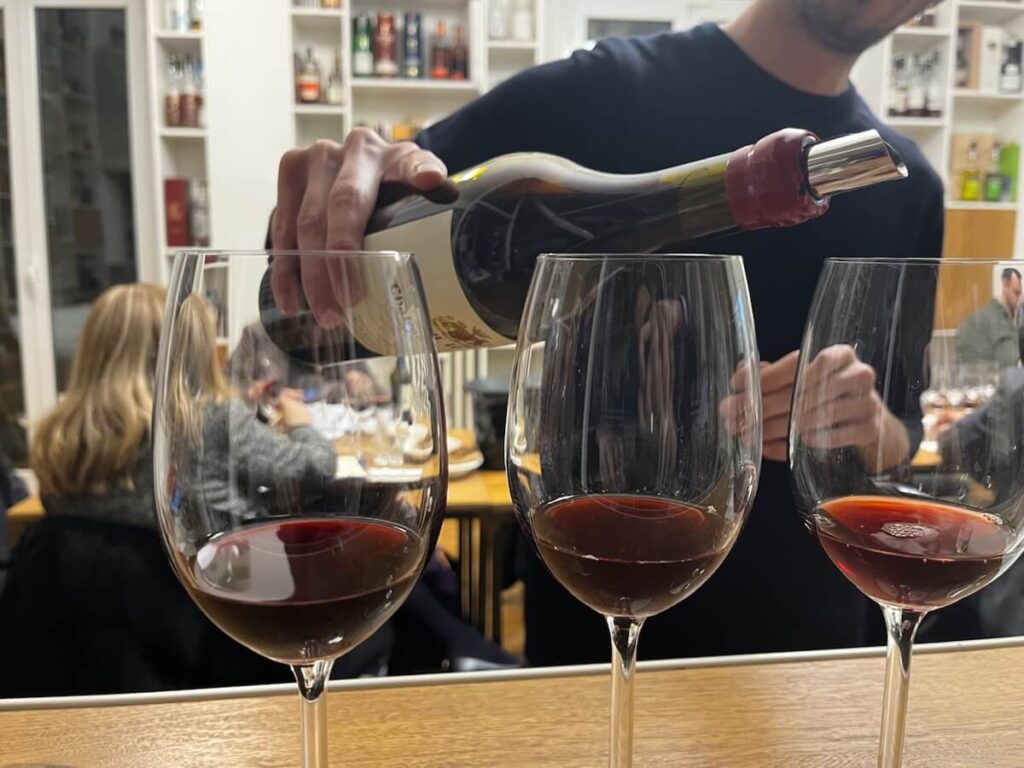
The vertical tasting showed how the wine moves through time without losing energy, progressively shifting its aromatic register and building a continuous dialogue between fruit, spices, balsamic notes and tertiary nuances.
Le Barthélemy 2020: fruit at the center
The 2020 vintage presents a profile still dominated by fruit. Plum and sweet damson emerge, accompanied by an acidic push reminiscent of blood orange. On the finish, light underbrush notes appear, beginning to broaden the aromatic perspective.
It is a version of Le Barthélemy still projected toward primary energy, yet already showing readable depth.
Le Barthélemy 2018 and the encounter with Mediterranean scrub
In the 2018 vintage, the wine evolves toward more complex registers. The fruit remains present but gives way to a finish that recalls Mediterranean scrub.
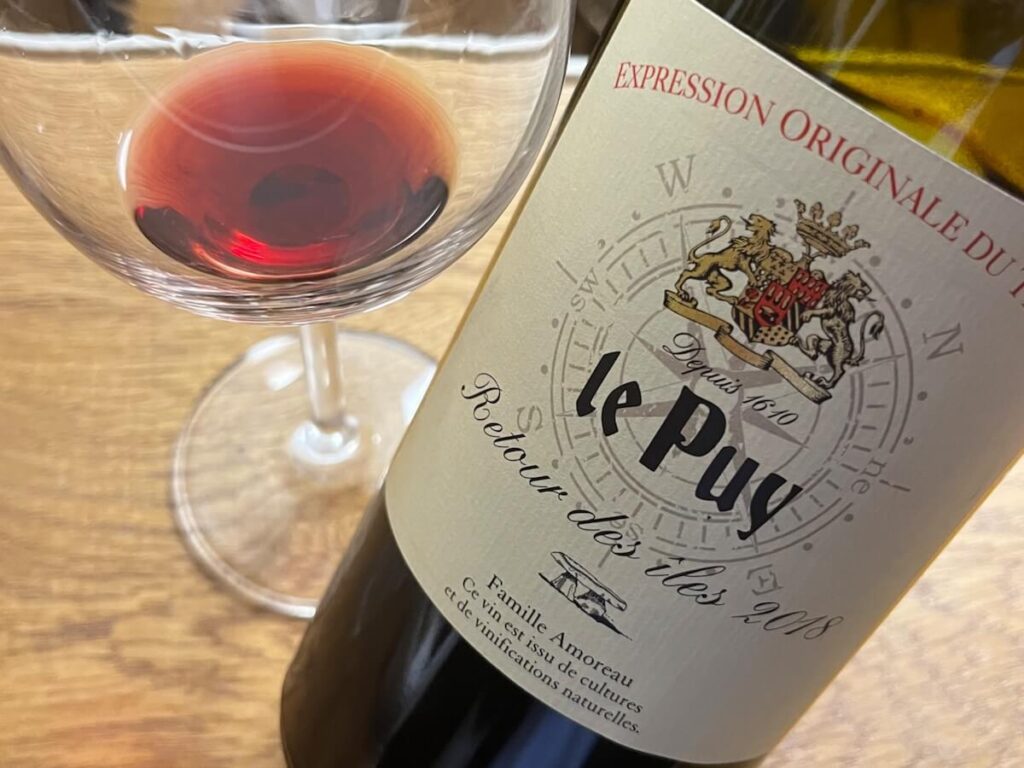
This trajectory becomes even more evident in the 1,200 bottles of 2018 Retour des Îles, selected from the best barrels of Barthélemy and subsequently aged at sea during an Atlantic crossing. Here, licorice, rosemary, sage and a more pronounced Mediterranean component emerge, with an aromatic evolution that sacrifices part of the fruit in favor of complexity.
Le Barthélemy 2014 and 2011: maturity, tobacco and balsamic depth
The 2014 vintage is marked by ripe cherry moving toward sweet orange and spirit‑soaked fruit, suggesting an advanced evolutionary phase.
In 2011, ripe red fruit gradually gives way to tobacco, underbrush and mushroom, leading to a balsamic finish that expands the wine’s complexity.
These vintages show how Le Barthélemy works through layering rather than immediate intensity.
Le Barthélemy 2008: when time leaves its mark
With 2008, tertiary notes take the lead. Tobacco and leather define the aromatic profile, while an unexpected saline note appears on the finish.
A bottle that speaks to the relationship between wine and time—an element that, in Le Puy’s philosophy, seems to carry the same weight as terroir.
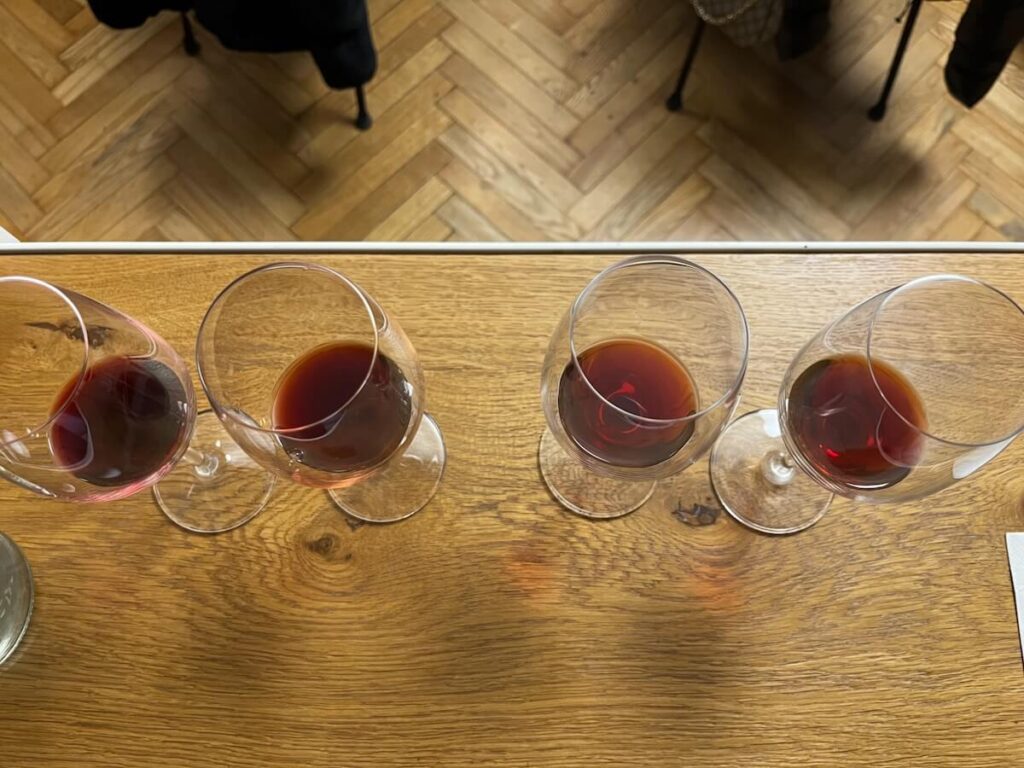
Le Puy: Bordeaux outside the rules
Today, Le Puy wines are present in more than 60 countries and appear on 51% of France’s three‑Michelin‑starred tables. A result built not by chasing the classic model of great Bordeaux, but by following an independent path rooted in regenerative agriculture, experimentation and radical fidelity to identity.
The Le Barthélemy vertical expresses precisely this: not the pursuit of perfection understood as standardization, but the ability of each vintage to express a different chapter of the same story. A story that began more than four centuries ago and continues today to question the future of wine, starting from the soil, biodiversity and the sometimes inexorable passage of time.


