


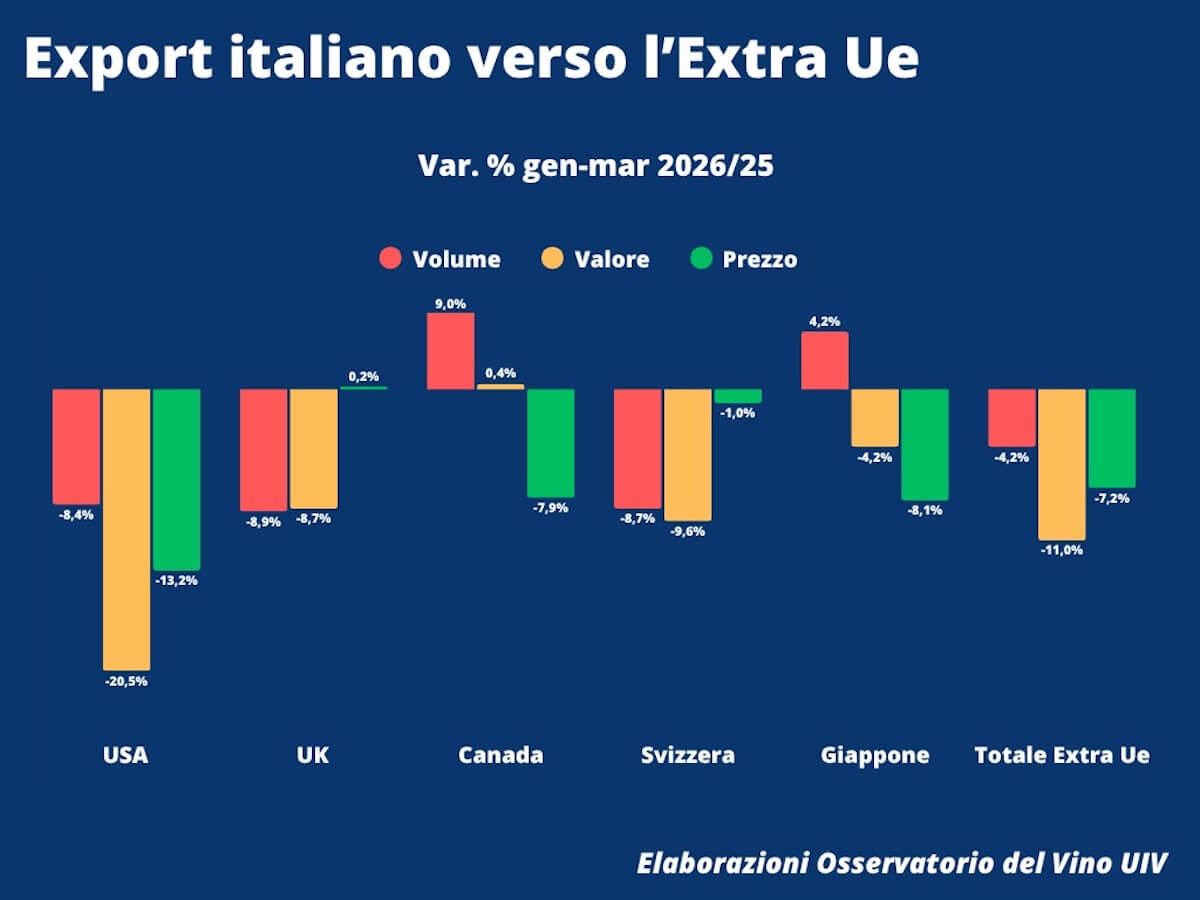
Italian wine exports outside the European Union are trying to slow their decline, but have not yet returned to balance. Data from the first quarter of 2026 show an improvement compared to previous months, without however reversing a trend that remains negative and continues to affect the main reference markets. According to the Observatory of Unione Italiana Vini, exports to non‑EU countries are approaching one billion euros, but still show an 11% year‑on‑year drop. A figure that softens the decline recorded in the early months of the year, yet confirms a fragile context in which recovery remains partial, especially given the uncertainties of the US market.
Non‑EU markets: stable volumes, value under pressure for Italian wine exports
The analysis of the main markets reveals a mixed picture. The US continues to be the most critical point, with a 20.5% drop in value and a significant contraction in prices.
The United Kingdom shows more stable dynamics, with a balance between volumes and value, while Canada records volume growth accompanied by a decline in average prices.
Switzerland shows a contraction in both value and volume, while Japan displays the opposite trend: rising volumes paired with a reduction in value, signalling price pressure.
Overall, the non‑EU total shows a widespread decline, with a significant reduction in value and a more contained drop in volumes, indicating a phase in which the market absorbs product but under less favourable economic conditions.
United States: consumption still falling
The real issue remains the US market. Despite some signs of stabilization, consumption data confirm a still‑challenging phase.
In the first four months of 2026, sales of Italian wine in the US fell by 7.2% in volume, while consumer prices rose by 4.3%, also due to discount policies adopted by producers to mitigate the effects of tariffs.
Categories show different behaviours: sparkling wines, especially Prosecco, perform better and record growth, while red, rosé and aromatic wines face greater difficulties, with sharper declines than the market average.
In this context, premium segments continue to show greater resilience, particularly in the HoReCa channel, confirming a polarization of demand.

New markets and emerging demand for Italian wine exports
Partially offsetting the slowdown in traditional markets are several emerging countries showing significant growth in demand. Russia, China, Brazil and Mexico stand out for their positive dynamics, helping to rebalance—at least in part—the overall export picture.
Although these markets still weigh less than the historic top buyers, they are becoming increasingly relevant in the international strategies of Italian producers.
The structural issue: balancing production with a market that has not yet recovered
Beyond short‑term data, the key point remains managing the balance between production, stocks and demand.
Lamberto Frescobaldi, president of Unione Italiana Vini, stresses the need for a cautious approach:
“The market data we observe indicate that, overall, the alert level remains high and that maximum attention is required. The imperative today is to measure our strength in order to keep the supply chain as balanced as possible and continue to guarantee the high quality level that Italian wine is universally recognized for.”
The message is clear: in a context of slow consumption and high stocks, increasing production risks adding further pressure on prices.
“In this phase, with already high stock levels, producing more than the market can absorb would risk generating harmful effects on prices at every level of the supply chain.”
The overall picture portrays a sector searching for a new point of balance. Italian wine continues to be in demand, but under different conditions than in the past, with greater attention to price, positioning and the balance between supply and demand.
The trajectory therefore remains open: signs of improvement are present, but a return to stable growth will depend on the sector’s ability to adapt to a market that has become more selective and less predictable.


