


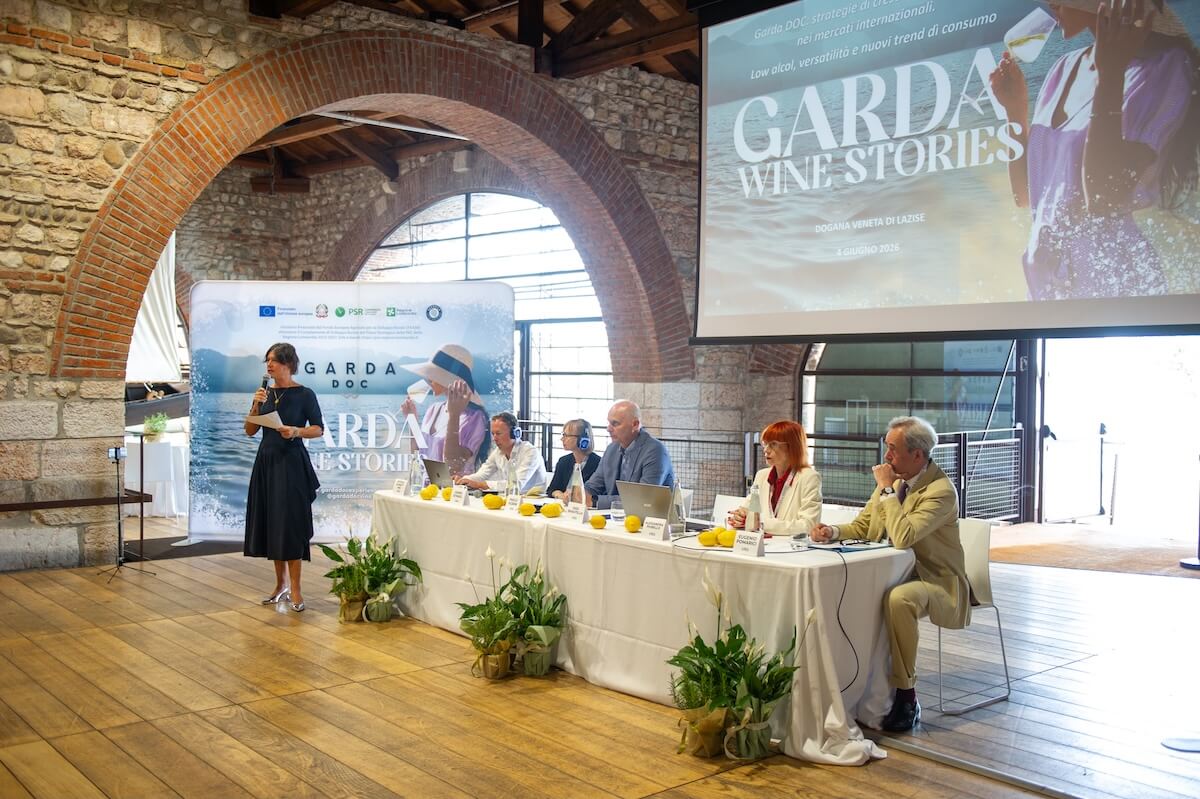
How can a denomination grow in a wine market that is changing rapidly, while traditional consumption slows and new categories capture consumers’ attention? This was the question guiding the conference “Garda Doc: growth strategies and perception in international markets. Low alcohol, versatility and new consumption trends”, organized by the Garda Doc Consortium at the Dogana Veneta in Lazise. The event brought together scholars, journalists, Masters of Wine and international professionals to analyze the transformations reshaping the global wine sector, with particular focus on low‑alcohol wines and the new consumption trends redefining the relationship between wine, wellbeing and lifestyle. The message that emerged was clear: the ability to interpret change is now one of the decisive factors for a denomination’s competitiveness in international markets.
Garda Doc: the challenge of new global consumption trends
The Lazise event was also an opportunity to take stock of the evolution of the Garda Doc denomination, which in recent years has experienced steady growth.
Opening the conference was the Consortium’s president, Paolo Fiorini, who illustrated the results achieved by the denomination. With over 23 million bottles of Garda Doc produced in 2025, it recorded its best result ever, consolidating a development path begun in 2016 and supported by the ability to offer contemporary, versatile wines aligned with market demands.
Among the most significant innovations introduced by the production regulations is the possibility of producing Garda Garganega with a minimum alcohol content of 9% Vol., a choice that positions the denomination among the most advanced in interpreting new consumer needs.
President Paolo Fiorini: “Interpreting change without losing identity”
Innovation was at the center of Paolo Fiorini’s address, in which he emphasized how low‑alcohol wines represent one of the main areas of development for the sector today.
“Addressing the topic of low‑alcohol wines today means carefully reading the evolution of international demand, understanding new consumption styles and anticipating the changes affecting the global wine sector,” stated the president of the Garda Doc Consortium. “More and more consumers are seeking versatile, contemporary wines aligned with a more mindful approach to drinking, without giving up quality, authenticity or the connection to place. In this scenario, the role of a denomination is to interpret change with responsibility and strategic vision, transforming new trends into growth opportunities for producers. As a Consortium, we were the first Italian denomination to introduce a reduced‑alcohol category into our regulations — a pioneering choice that demonstrates Garda Doc’s commitment to innovation and to providing producers with concrete tools to respond to international market demands while remaining firmly anchored to our identity. This is the spirit behind this conference within Garda Wine Stories: a project that goes beyond promoting the denomination and aims to become a permanent observatory on wine markets, consumers and the trends shaping their choices. Bringing analysts, journalists, Masters of Wine, professionals and producers to the same table means building knowledge, fostering dialogue and offering companies useful tools to face future challenges with greater awareness. Garda is a territory that has always evolved without losing its identity: the growth of our denomination depends on our ability to look ahead, invest in innovation and continue to enhance what makes us unique in the Italian wine landscape.”

The NoLo phenomenon and the prospects of reduced‑alcohol wine
One of the most explored topics during the conference was the NoLo segment, the acronym identifying low‑ or no‑alcohol products.
Professor Eugenio Pomarici of the University of Padua highlighted how this category is currently one of the most dynamic in the global wine landscape. Although still a young segment, its growth rates are particularly significant and run counter to the general decline in traditional wine consumption.
According to the analysis presented, the future success of this category will depend on further improving product quality, advancing dealcoholization technologies and supporting research and innovation.
United Kingdom and Germany: two key markets for the wine of the future
The discussion on international markets was particularly insightful, with two dedicated focuses on the United Kingdom and Germany.
Patrick Schmitt MW, editor‑in‑chief of The Drinks Business, illustrated how the British market is undergoing profound transformation. Changing consumption habits and the introduction of tax systems increasingly linked to alcohol content are favoring the growth of low‑alcohol wines, considered one of the most promising categories for the sector’s future. Demand is driven by the search for lighter products aligned with wellbeing‑oriented lifestyles and moderate consumption.
From the German market came equally significant signals. Karin Eymael, editor‑in‑chief of Weinwirtschaft and Meininger’s International, highlighted strong growth in non‑alcoholic and low‑alcohol wines, supported by greater health awareness, technological innovation and evolving lifestyles. In one of the world’s most important markets for Italian wine, denominations capable of combining territorial authenticity, sustainability and quality may find new opportunities for development.

Between innovation and identity: the cultural challenge of wine
The debate did not focus solely on economic and commercial aspects.
Alessandra Piubello, journalist for Decanter, addressed the topic of low‑alcohol wines from a cultural perspective, offering a reflection on the role these categories may play in the future of the sector. At the center of her talk was the relationship between innovation, identity and new consumption habits, with a question that will accompany wine in the coming years: how can the sector evolve without losing authenticity and cultural value?
A question that concerns not only producers, but the entire global wine industry.
Garda Doc as an observatory of global trends
The final roundtable, moderated by oenologist and wine expert Sissi Baratella, confirmed the denomination’s intention to take an active role in market analysis and in interpreting ongoing transformations.
From the discussion among speakers, producers and opinion leaders emerged the need to continue investing in research, communication and knowledge of international markets, while enhancing the distinctive elements that have supported Garda Doc’s growth: production versatility, territorial identity and the ability to anticipate changes in contemporary consumer behavior.
At a time when wine is called to respond to new sensitivities and new consumption models, Garda Doc chooses to face change not as a threat but as an opportunity. A strategy that looks to the future without abandoning its roots, aiming to transform innovation and knowledge into concrete tools for the denomination’s continued growth.


