



Federvini’s analysis can be summed up in one sentence: the wine sector is facing one of the most complex phases of recent years. Slowing exports, shifting global consumption patterns and commercial tensions are reshaping the balance of the world market. Yet the strength of Made in Italy and geographic diversification offer new growth opportunities.
The market is undergoing a profound transformation. This is driven not only by the tariffs introduced by the United States or the geopolitical tensions reshaping international trade relations, but also by structural changes in consumption models emerging across major global markets. This is the picture that emerged during Federvini’s General Assembly, where the association presented a detailed analysis developed with Nomisma Wine Monitor on the sector’s health and
.

According to Federvini, the industry is now facing a true “new world disorder,” marked by geopolitical instability, trade wars, rising tariff barriers and growing economic uncertainty. A context that is inevitably slowing international trade and putting pressure on all major producing nations.
“2025 has tested us with unprecedented intensity,” said Federvini President Giacomo Ponti. “First reciprocal tariffs, then their suspension, and now the current 10% regime in force until July 24. Our companies have shown extraordinary adaptability. Now it is essential that the ratification of the EU–US agreement is concluded quickly: we cannot think of replacing the American market, but we can and must diversify, innovate and be even more present at European negotiating tables. We look to the future with confidence: we carry a strategic value—economic, cultural and identity‑based—that no tariff can undermine.”
Global exports slow down: wine suffers the most
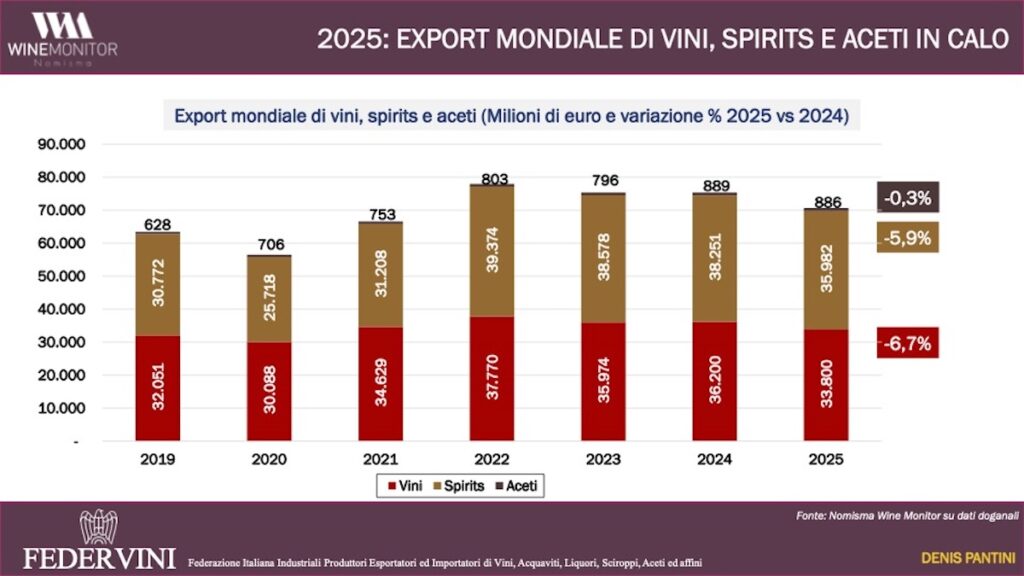
The numbers confirm the slowdown. In 2025, global wine trade fell by 6.7% in value compared to the previous year, dropping to 33.8 billion euros. Spirits also declined (-5.9%), while vinegar remained essentially stable (-0.3%).
Italy was not spared. National wine exports closed 2025 at 7.78 billion euros, down 3.7% from 2024. Spirits fell 5%, while vinegar limited losses to 2.7%.
According to Denis Pantini of Nomisma Wine Monitor, the slowdown cannot be attributed solely to US tariff policies. It is a global phenomenon affecting all major consumption markets and reflecting deeper changes in purchasing and consumption habits.
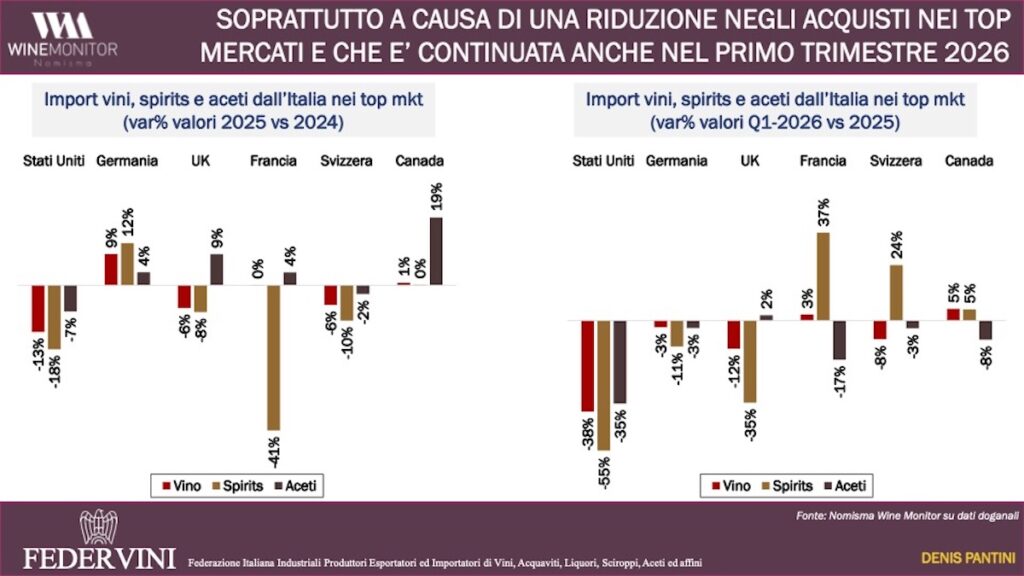
The most evident impact comes from the United States, the leading non‑European market for Italian wine. In Q1 2026, total imports of wine, spirits and vinegar across the twelve main global markets fell by 17.1% in value year‑on‑year. The US posted the worst performance, collapsing by 38.9%, followed by China (-10.6%) and Canada (-10.5%).
For Italian wine, the US figure is particularly significant: in Q1 2026, US imports of Italian wine dropped by 38%, spirits by 55%, and vinegar by 35%.
This situation stems from the uncertainty generated by the introduction of reciprocal tariffs between the US and the EU, later suspended and replaced by a temporary 10% tariff regime pending a final agreement. A framework that, according to Federvini, continues to hinder investment and commercial strategies.
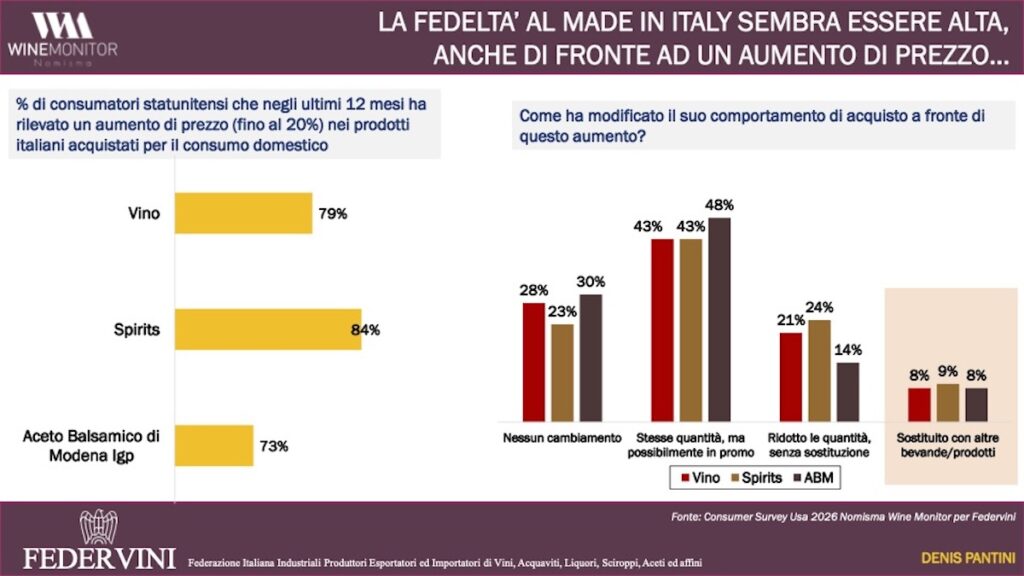
One of the most interesting insights from Federvini’s analysis concerns the structural evolution of consumption. Looking at major global markets from 2015 to 2025, wine demand is clearly being redefined. US consumption remains slightly above 2015 levels (+1%), but France is down 17%, Germany 13%, Italy 6% and the UK 4%. These markets represent about half of global wine consumption, showing how the slowdown is also linked to demographic, cultural and generational factors.
The post‑pandemic era has accelerated shifts in consumption habits. Younger generations show greater health awareness, lower consumption frequency and growing openness to alternative categories, including low‑ or no‑alcohol beverages. A trend affecting all major advanced economies.
While exports show weakness, the domestic market offers signs of resilience. In Q1 2026, wine sales in Italian large‑scale retail fell slightly in volume (-1%) but grew in value (+2.2%), indicating ongoing premiumisation. Sparkling wines continue to drive the sector, up 8.7% and extending a positive trend lasting over five years. Still and semi‑sparkling wines are more challenged (-2.4%).
Out‑of‑home consumption shows mixed dynamics. Inflation and reduced purchasing power are weighing on traditional dining, while the premium segment remains solid: 55% of high‑end restaurant customers say they always drink wine or sparkling wine with meals, compared to 25% in mid‑range venues and 11% in lower‑end establishments. Moreover, 67% of consumers consider wine quality a key factor in the overall dining experience.
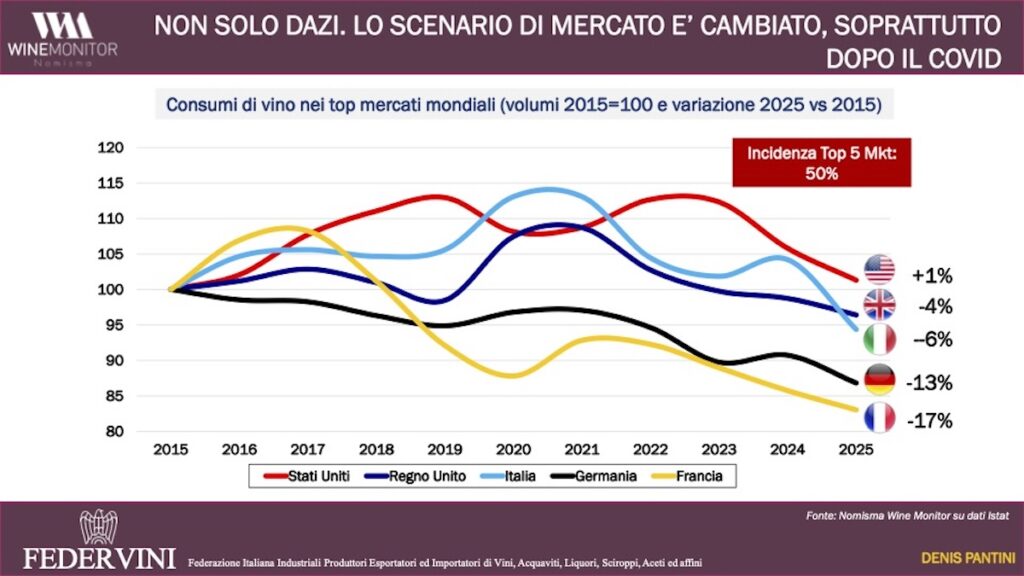
Despite challenges linked to tariffs and rising prices, Nomisma’s survey of 1,200 US consumers offers encouraging signs for Made in Italy. Most respondents reported price increases of up to 20% on Italian products in the past year. Yet fewer than 10% said they had replaced Italian products with alternatives. In wine, 28% did not change their purchasing habits and 43% continue to buy the same quantities, sometimes taking advantage of promotions.
This loyalty is rooted in reputation: 47% of US consumers identify high quality as the main reason for buying Italian wine, and 39% consider Italy the producer of the best imported alcoholic beverages—ahead of France and all other competitors.
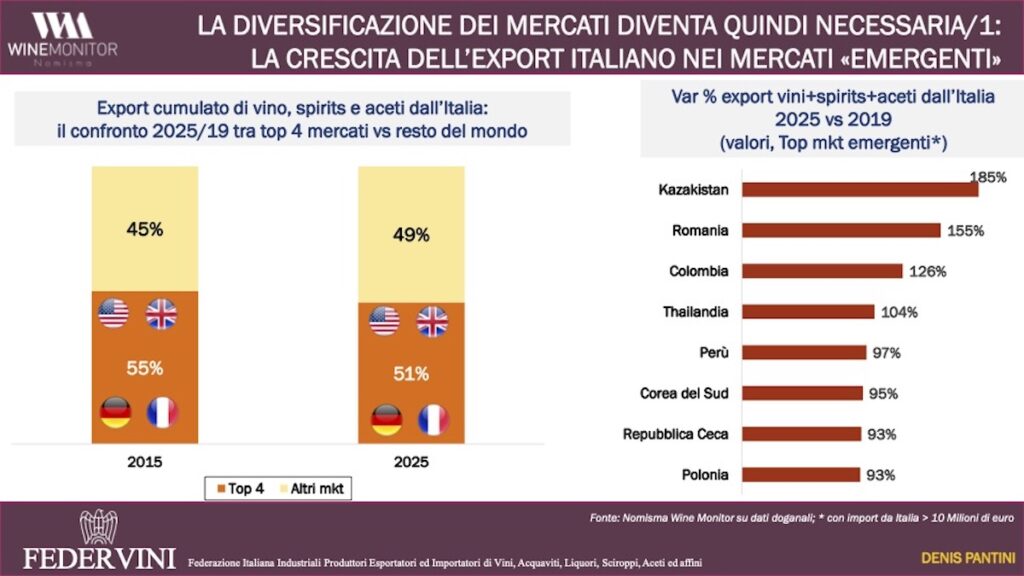
For Federvini and Nomisma, the answer to uncertainty in traditional markets lies in geographic diversification. In 2015, the four main destination markets accounted for 55% of Italian exports of wine, spirits and vinegar; by 2025, their share had fallen to 51%, highlighting the growing importance of emerging destinations.
Some markets once considered marginal are now highly dynamic. From 2019 to 2025, Italian exports grew by 185% in Kazakhstan, 155% in Romania, 126% in Colombia, 104% in Thailand, 97% in Peru and 95% in South Korea. Poland and the Czech Republic also show increases above 90%.
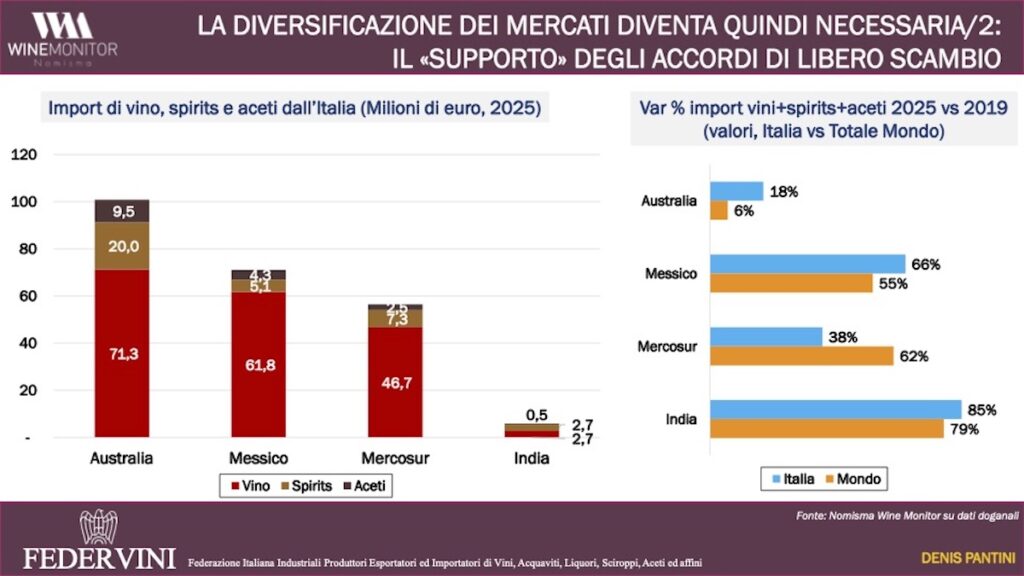
Free‑trade agreements are becoming increasingly important. Australia, Mexico, Mercosur countries and India are areas where Italian exports have grown at rates equal to or above global trade, demonstrating how trade openness can offset difficulties in mature markets.
Federvini: Europe needs a stronger trade policy
Federvini President Giacomo Ponti’s message is clear: the US market is irreplaceable, but the sector cannot afford to depend on a limited number of destinations. The federation therefore calls for a swift conclusion of EU–US trade negotiations, while urging companies to invest in innovation, internationalisation and geographic diversification.
The underlying belief remains unchanged: Italian wine continues to benefit from a unique reputational, cultural and qualitative heritage. In an increasingly fragmented and competitive global landscape, the ability to enhance this intangible capital—together with opening new markets—will determine the sector’s growth in the coming years.
Domestic market: spirits and vinegar rebound, sparkling wines keep growing
According to the Federvini Observatory with Nomisma, Q1 2026 in Italian large‑scale retail shows diverging trends. Wine declines slightly in volume (-1%) but grows in value (+2.2%), with sparkling wines accelerating (+8.7%). Spirits rebound more strongly (+2.9% in volume), driven by alcoholic aperitifs and sodas; gin is growing, while grappa remains negative. Vinegar shows positive signs, with sales rising both in value (+2.4%) and volume (+1%), driven by the strong performance of apple cider vinegar and the stability of Balsamic Vinegar of Modena PGI.

Out‑of‑home opportunities, but income–cost gap weighs
Data from the Federvini Observatory with TradeLab show that total out‑of‑home consumption closed 2025 at 102 billion euros, with 9.6 billion visits. Independent restaurants lead the sector with around 55 billion euros, slightly up from the previous year.
Consumption patterns vary significantly by spending capacity and venue type. Among high‑end restaurant customers, 55% say they always drink wine or sparkling wine; the figure drops to 25% in mid‑range venues and 11% in lower‑end establishments. Similar trends apply to bitters and after‑dinner drinks. For 67% of consumers, choosing a good wine significantly enhances the dining experience.
Preferences are also evolving, especially among younger consumers, with growing interest in organic or natural wines (considered appealing by 53% of 18–24‑year‑olds) and, more selectively, low‑ or no‑alcohol wines. These trends do not undermine the centrality of traditional categories but confirm the importance for companies of embracing new consumption languages and generational shifts.


