


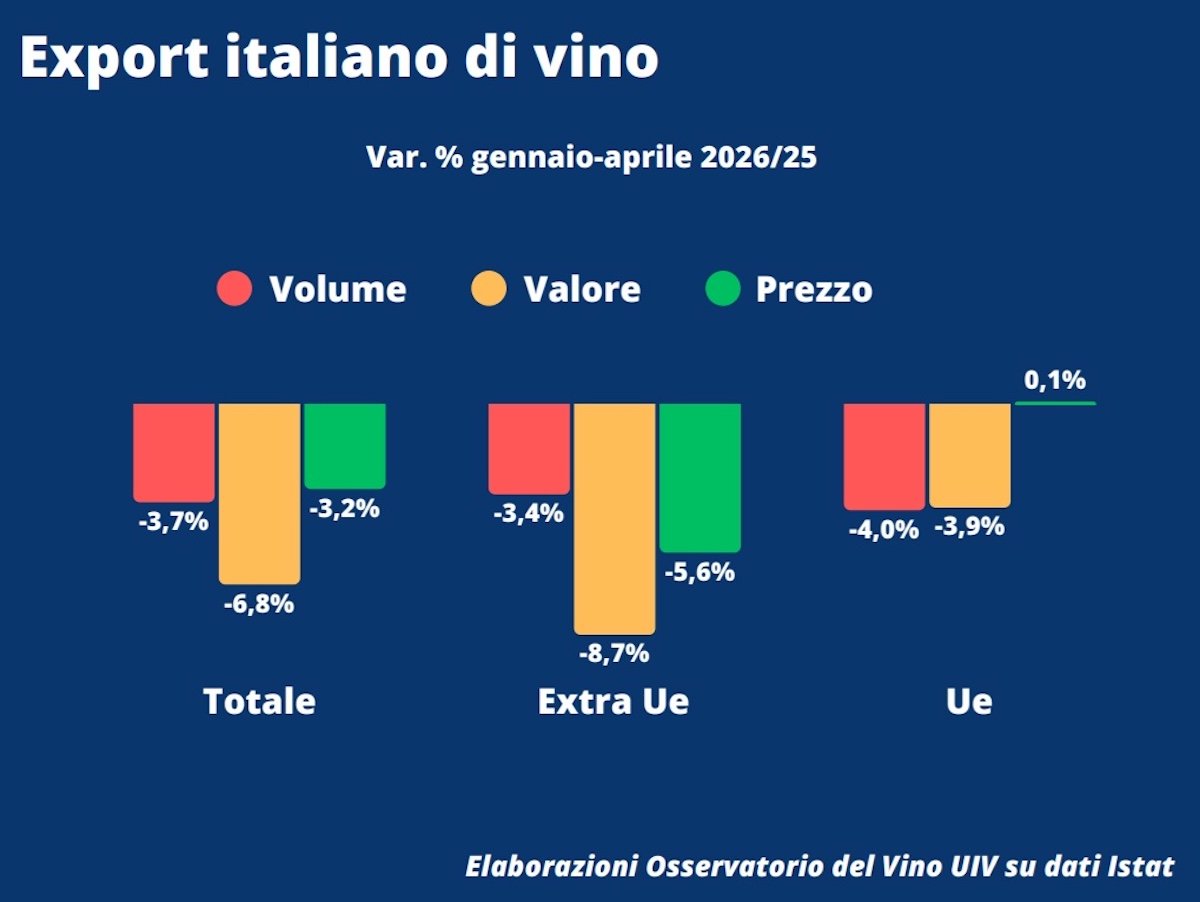
Italian wine exports continue to suffer from difficulties in international markets. In the first four months of 2026, exports reached €2.34 billion, with a decline of 6.8% in value and 3.7% in volume. The downturn is driven mainly by the performance of the main destination markets, starting with the United States which, despite a timid positive signal in April, remain firmly in negative territory in the overall yearly balance. Supporting the picture instead are several emerging markets, particularly Brazil and China, which continue to record significant growth rates. This is what emerges from the analysis by the Observatory of Unione Italiana Vini, which processed the latest Istat data, confirming a delicate phase for international wine trade.
The first quarter closes in the red
Between January and April 2026, Italian wine exported a total value of €2.34 billion. The 6.8% decline compared to the same period of the previous year also affects volumes, which stood at 641 million liters, down 3.7%.
The slowdown affects both non-European and Eu markets. Extra-Eu exports fell by 8.7%, while within the European Union the decline stopped at 3.9%, although showing a worsening compared to previous data.
The picture confirms the persistent weakness of international demand and the growing pressure on Italy’s main reference markets.
USA, Germany and the United Kingdom remain the main brakes on Italian wine exports
Market data clearly show the weight of the slowdown among major international buyers.
In April, the United States recorded the first positive signal after ten consecutive months of contraction, with monthly growth of 1.6%. However, the quarterly balance remains heavily negative, with a 15.4% drop.
Germany and the United Kingdom also continue to show difficulties. The German market fell by 6.8%, while the UK closed the first four months of the year at -6.1%.
Among the top five destination markets, Canada remains broadly stable, while Switzerland recorded a 12.7% decline.
These figures show that the crisis does not concern isolated geographical areas but affects many of the main historical destinations for Italian wine.
Brazil and China lead growth among emerging markets
Despite the overall difficult scenario, some areas offer encouraging signs.
Brazil continues to be one of the most positive surprises of the year. Thanks to strong momentum since early 2026, the Brazilian market closed the period with growth of 17.8%.
Even more significant is the performance of the Mercosur area as a whole, which recorded a 36.4% increase.
China also continues its recovery, with growth of 9.7%, while Russia posted a 28% increase, though showing a gradual slowdown compared to the exceptional pace of the early months.
In May, the US worsens again
The most recent data, covering the first five months of the year in non-Eu countries, confirm persistent challenges.
According to UIV, the January–May balance shows a 7.5% decline in value and 3.9% in volume.
The situation in the United States is particularly significant: May shipments fell by around 15% in value. At the same time, the average price of Italian wine exported to the US in 2026 dropped by 10%.
Negative trends also strengthened in the UK (-6.7% over five months) and Switzerland (still at -12.7%).
Canada, China and Brazil continue to show greater resilience.

Frescobaldi (UIV): “A balance between supply and demand is needed”
Faced with this scenario, the president of Unione Italiana Vini, Lamberto Frescobaldi, urges the sector to reflect on the need for strategies capable of combining value creation and sustainable production.
“These results confirm the difficulties of the wine market and its commercial exchanges, which are contracting for all producing countries. Greater presence in established and emerging markets, along with reduced production, are the two simultaneous directions Italian wine must pursue. The current situation forces us to acknowledge that we are in a phase where it is not only necessary to promote our wine even more, but also to recognize that large quantities placed on the market do not help enhance its value. We must aim for a balance between supply and demand that supports the value of Italian wine, protecting business income and the sector’s competitiveness.”
The data processed by Unione Italiana Vini highlight a shift that goes beyond the simple contraction of exports. Price pressure, slowing demand in traditional markets and the growing importance of emerging destinations are redefining the sector’s strategic priorities. In this context, the ability to secure new consumption areas while defending the value of production becomes one of the central challenges for Italian wine.
Exports remain the engine of the sector, but 2026 confirms that the game is no longer played solely on volumes. Increasingly decisive will be the ability to build value, strengthen the international positioning of denominations and identify new markets capable of supporting future growth.


