

Prosecco DOC sales in China rose by more than 30% in the first half of 2026 compared with the same period a year earlier. The sharp increase comes alongside an original initiative in Beijing, where the Prosecco DOC Consortium introduced its sparkling wines to students at two universities, UIBE and BLCU. Led by AIS sommelier David Cheng, two masterclasses brought together more than 100 Chinese students. But the experience went beyond wine education: members of Generation Z were invited to develop new slogans and communication concepts for one of Italy’s best-known sparkling wines.
Prosecco DOC in China: A Small but Promising Market
China currently accounts for approximately one million bottles of Prosecco DOC a year, representing just 0.2% of the appellation’s total exports. Its share remains modest, but the market is strategically important and offers considerable potential for further growth.
The wider figures illustrate the scale of Prosecco DOC’s international presence. Stretching across Veneto and Friuli-Venezia Giulia, the appellation encompasses 12,322 winegrowers, 1,110 winemaking companies and 350 sparkling wine producers.
In 2025, production reached 667 million bottles, with an estimated retail value of €3.6 billion.
Commenting on the results, Giancarlo Guidolin, President of the Prosecco DOC Consortium, said:
“Prosecco DOC has become an ambassador for the Italian way of life around the world, and the success of these masterclasses is further confirmation of that. The Chinese market, which recorded an excellent 30% increase in the first half of 2026, offers us a fresh perspective on a market where our appellation aims to grow with respect, curiosity and a long-term vision.”
From the Martinotti Method to the Spritz: Bringing Prosecco DOC into the Classroom
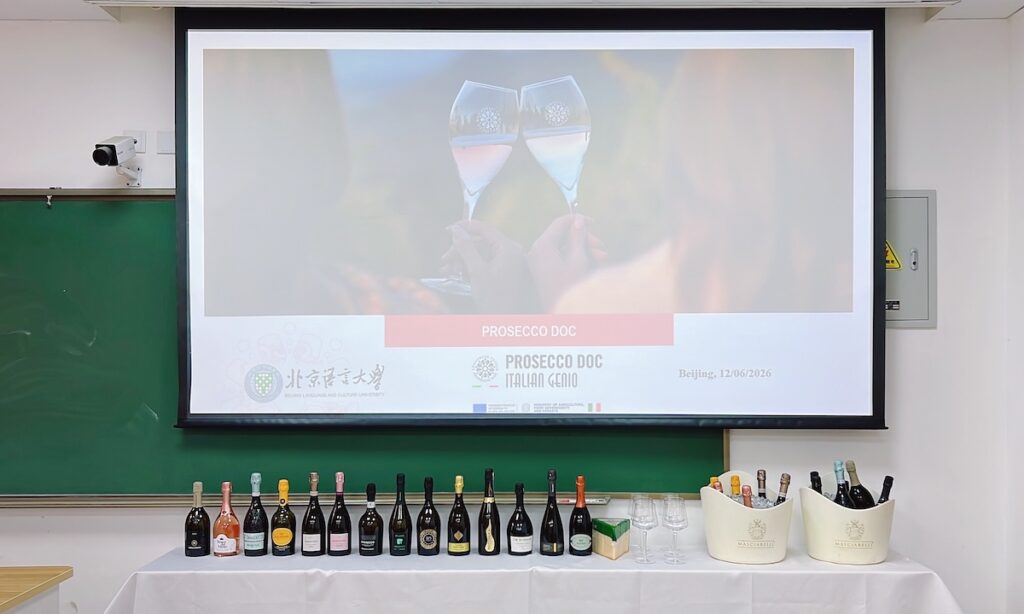
Against this backdrop, the Consortium partnered with the University of International Business and Economics (UIBE) and Beijing Language and Culture University (BLCU) to introduce Chinese students to the world of Prosecco DOC.
During the two masterclasses, David Cheng explored the history of the appellation and the Martinotti Method before guiding participants through wine tastings and a mixology session featuring the classic Spritz.
The wines came from 13 producers representing Prosecco DOC: Borgo Molino, Bosco del Merlo, Bottega, Brilla!, Cantina Trevigiana, De Stefani, La Gioiosa, Masottina, Martellozzo, Paladin, Piera 1899, Tenuta Sant’Anna and Valdo.
“The Guest from Afar”: How Chinese Gen Z Is Reimagining Prosecco DOC
The most distinctive part of the initiative, however, was its creative challenge.
Students were invited to reinterpret the Prosecco DOC brand, beginning with its name. They proposed Chinese characters associated with joy, effervescence and conviviality, drawing inspiration from the idea of welcoming “the guest from afar”: Prosecco DOC itself.
Their proposals extended well beyond language, exploring promotional strategies tailored to Chinese consumers.
Ideas ranged from partnerships with television programmes focused on wellbeing and slow living to collaborations with local brand ambassadors. Other suggestions included co-branding projects inspired by guochao, the cultural trend that celebrates contemporary interpretations of Chinese identity through products, design and communication.
Students also imagined introducing Prosecco DOC into relaxed afternoon occasions, opening up new possibilities for how the sparkling wine might fit into everyday social life.
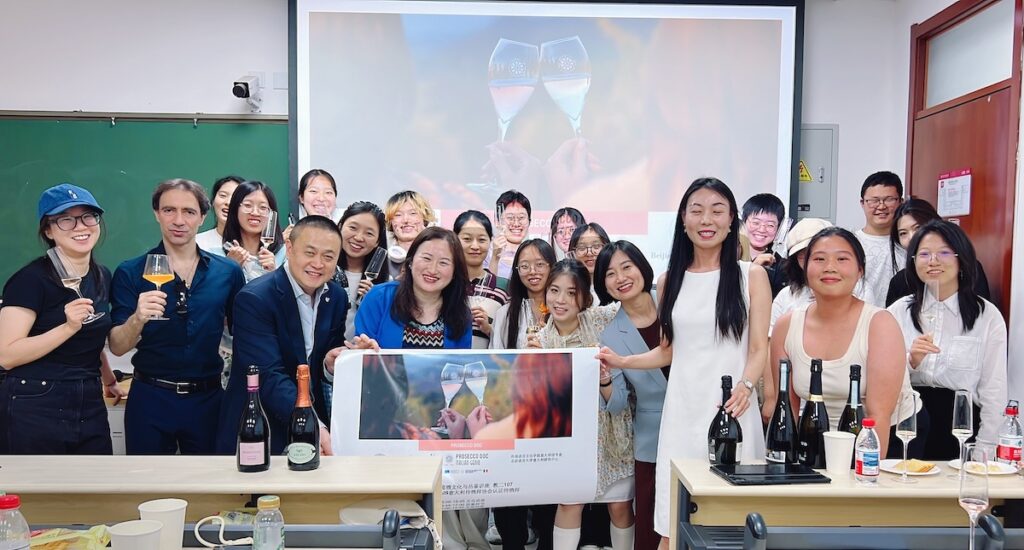
These linguistic reinterpretations aim to make the Prosecco DOC name more accessible and appealing to Chinese consumers while creating a narrative rooted in cultural meaning.
In this vision, Prosecco becomes a natural part of dining and celebrations, bringing with it the values of hospitality, joy and togetherness.
Professors Wang Ying of UIBE and Zhang Yuan of BLCU also emphasised how the project illustrates the ability of Italian aesthetics and food and wine culture to connect different worlds.
For the Consortium, the students’ proposals offer practical insights that could help shape future campaigns to strengthen Prosecco DOC’s positioning in China.
Guidolin is already looking ahead:
“Prosecco DOC speaks a universal language of joy and conviviality. Seeing young Chinese students reinterpret it with such freshness confirms that cultural dialogue is the right path forward. When wine is authentic and rooted in its place of origin, it can build bridges between cultures. These results provide concrete inspiration for our future promotional strategies, and we thank UIBE, BLCU and David Cheng for making this dialogue possible.”